Originally written for Rene Herse: https://www.renehersecycles.com/becca-wins-24-hrs-in-the-old-pueblo/
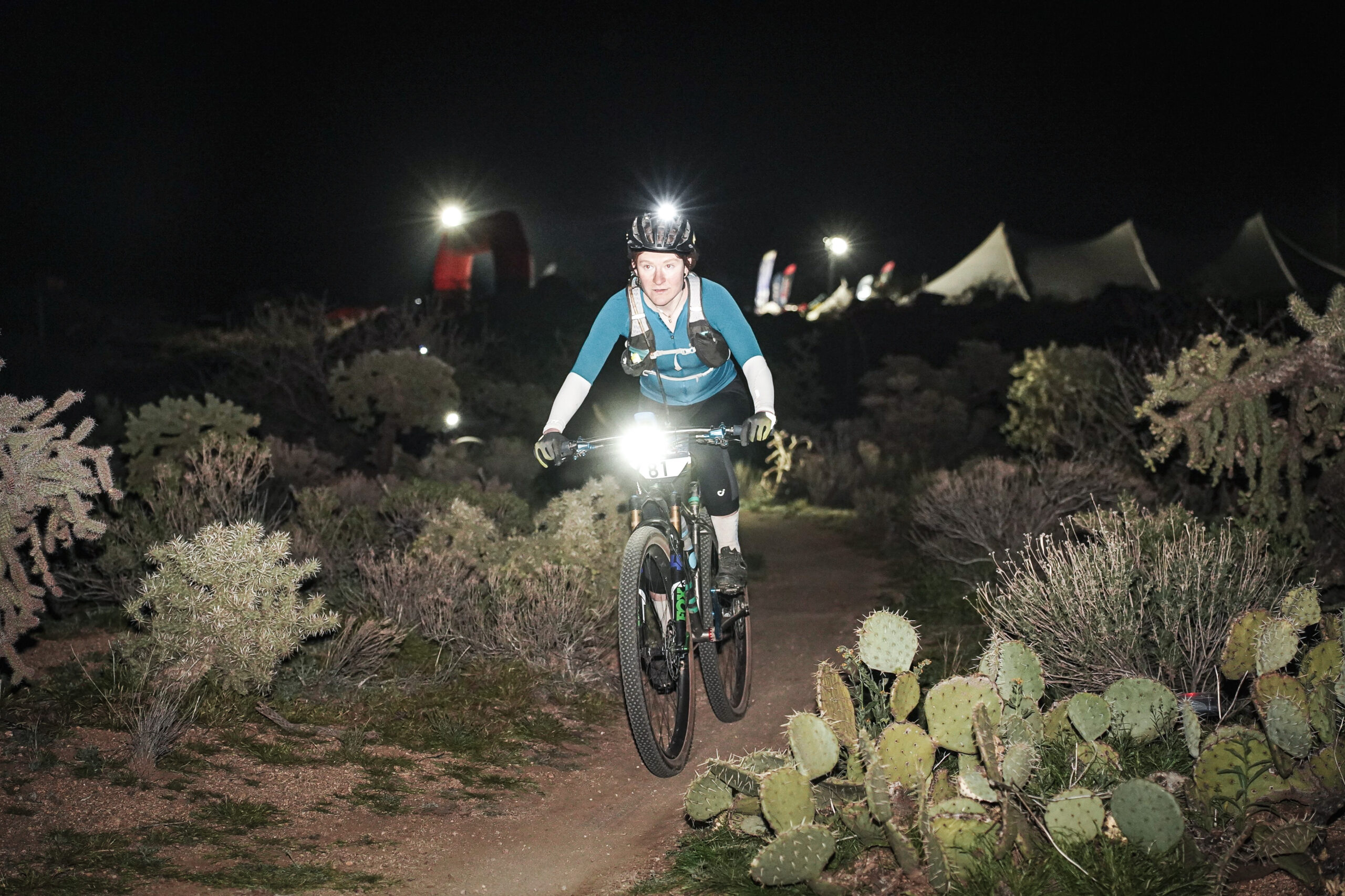
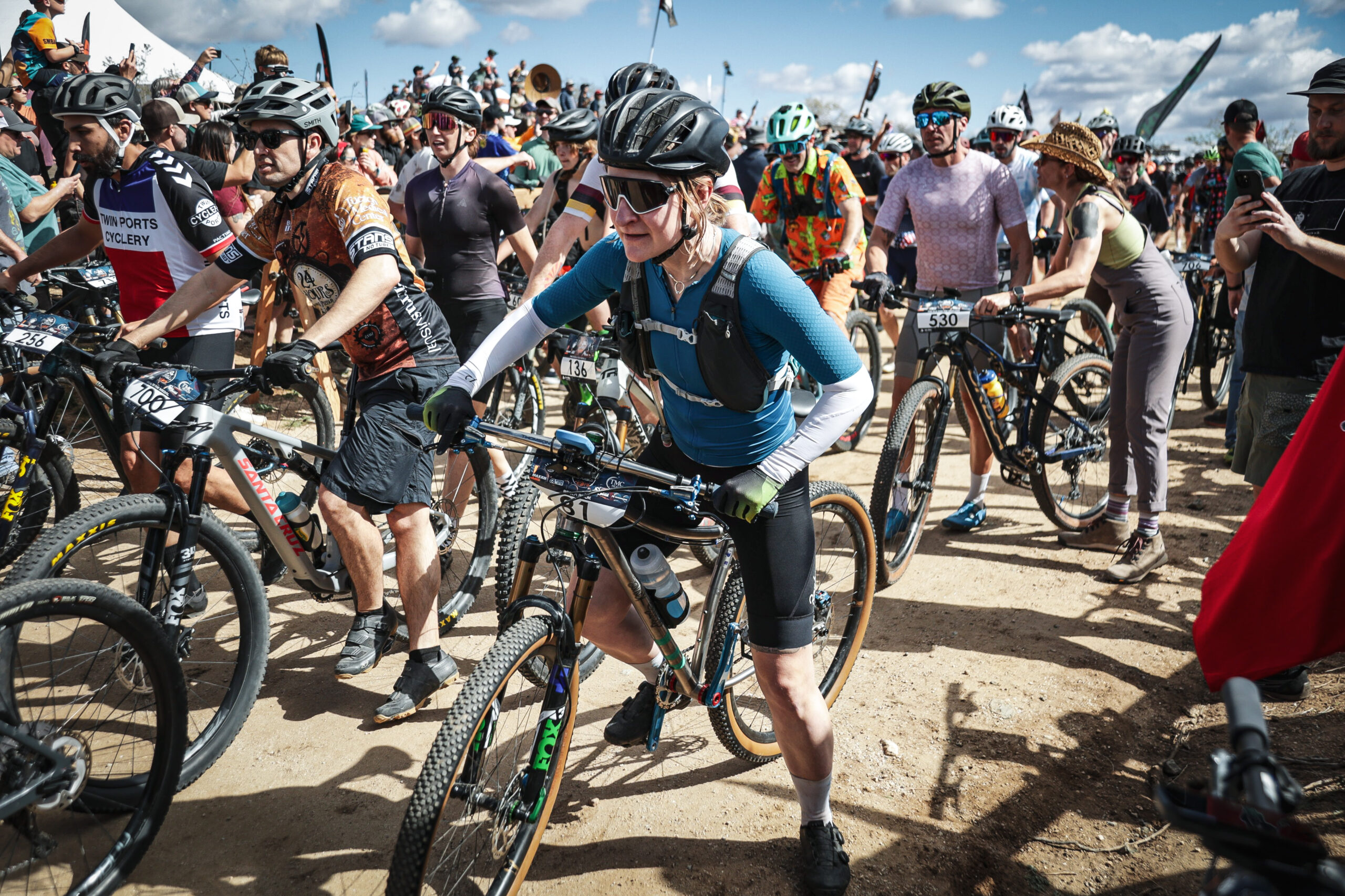
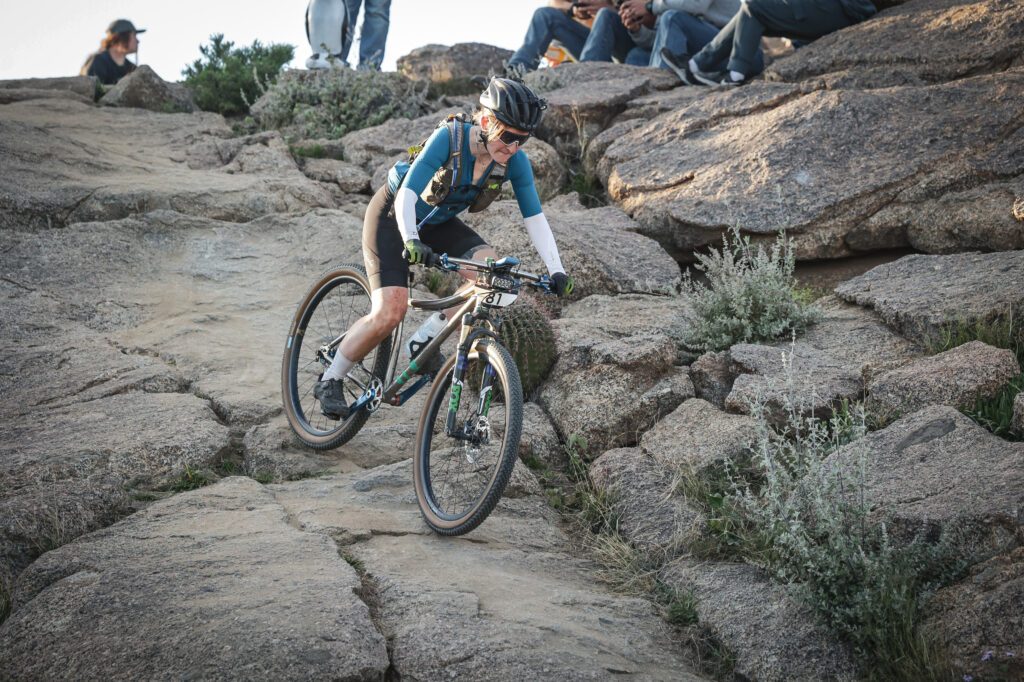
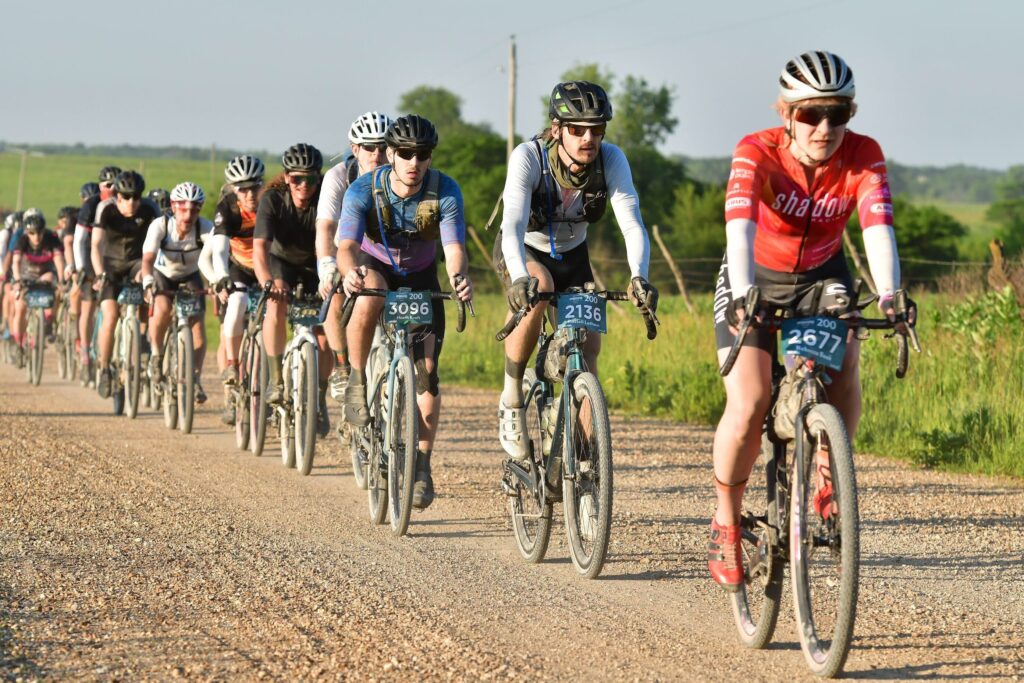
The iconic Le Mans-style start meant that I was one of 600+ riders who were running to our bikes, jumping on and racing into the desert. After escaping the inevitable chaos that comes with this arrangement, I settled into a fast pace, throwing down 75- to 85-minute times for the 16.5 mile lap from noon until sunset.
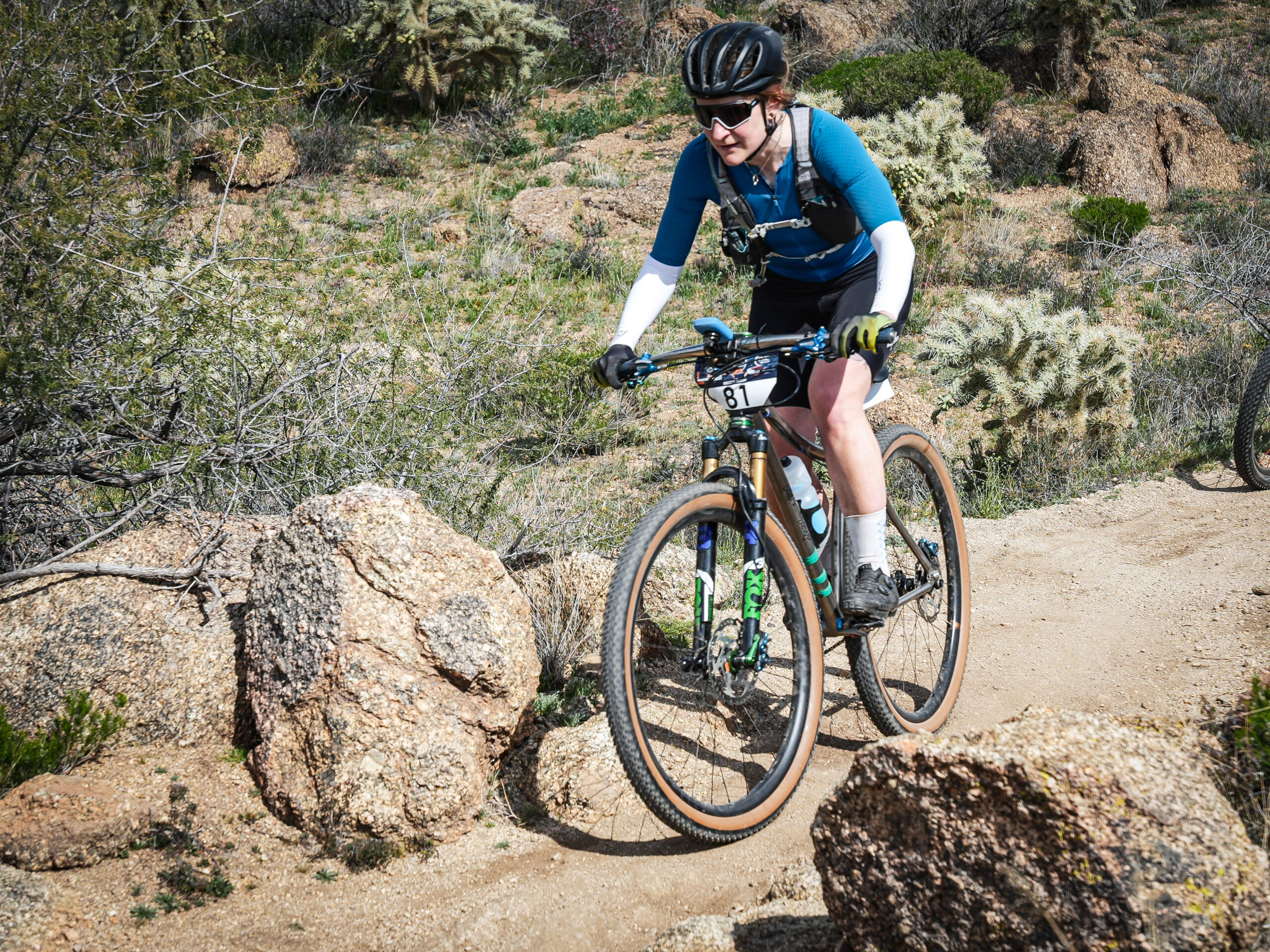
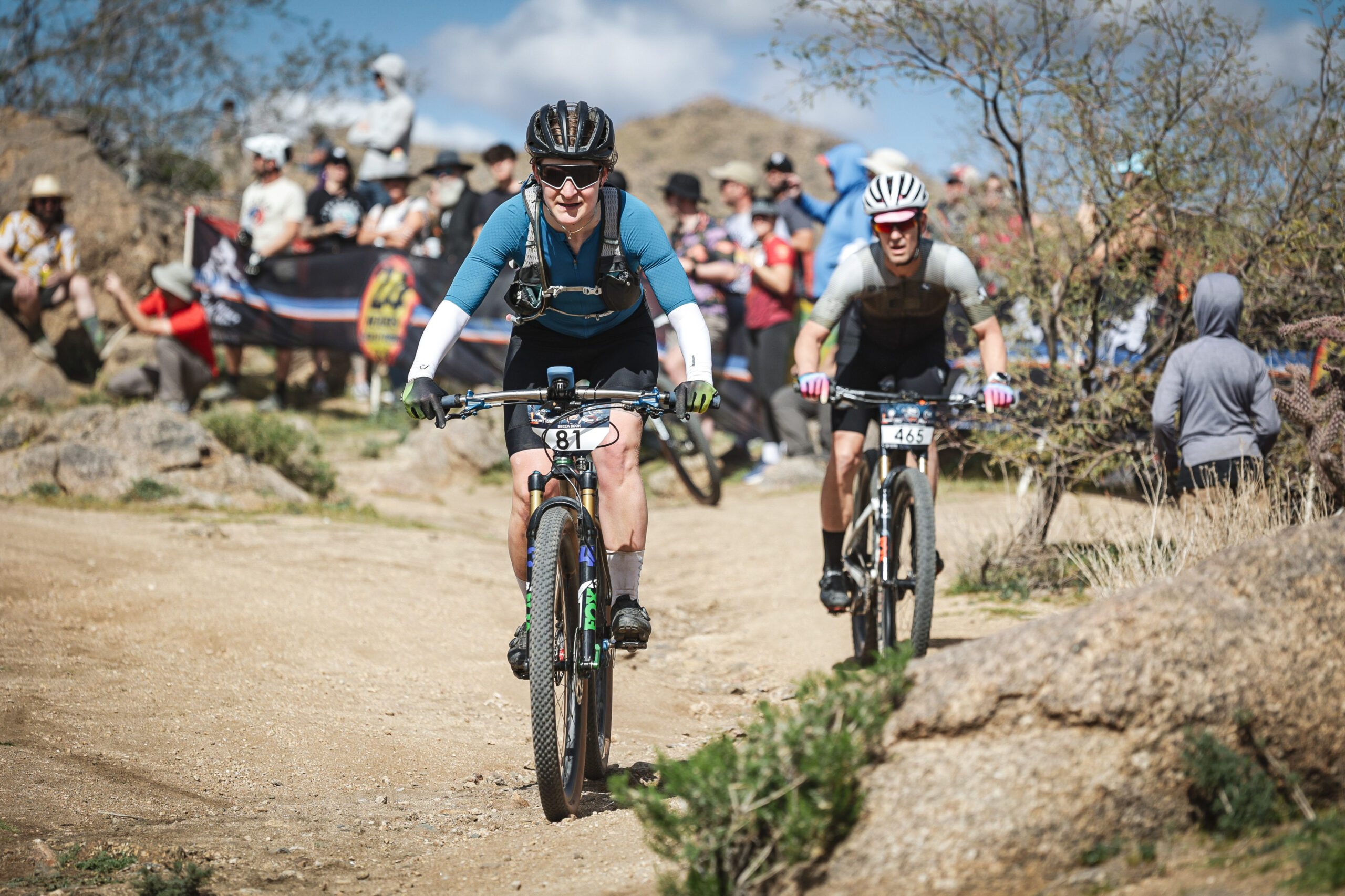
The course is has a variety of classic desert riding, dense cacti forests of chollas and saguaros, rock gardens, and one iconic rock roll. My Rene Herse Fleecer Ridge Endurance tires were fast and grippy on all of it. Set up tubeless with Rene Herse Supple Sealant, they were also immune to cactus spines! My lap times inevitably slowed during the long 13-hour night, but I focused on keeping my stopped time to a minimum—thanks to the support of my amazing fiancé. What more could a gal want for Valentine’s Day than 7.5 liters of high-carb drink mix?
After a stunning desert sunrise, the bulk of 24-Hour-Town started to wake up again. I felt slow next to the well-rested relay teams, but was still able to push out 95-minute laps, so I guess my 32 x 19 gear ratio (with a Wolf Tooth chainring) was the right choice. I kept trucking consistently for 246 miles (396 km) / 15 laps / 23 hours until my dropper post refused to stay up. With the single-speed solo win easily within reach, I pulled off early, finishing just one lap short of the women’s geared winner.
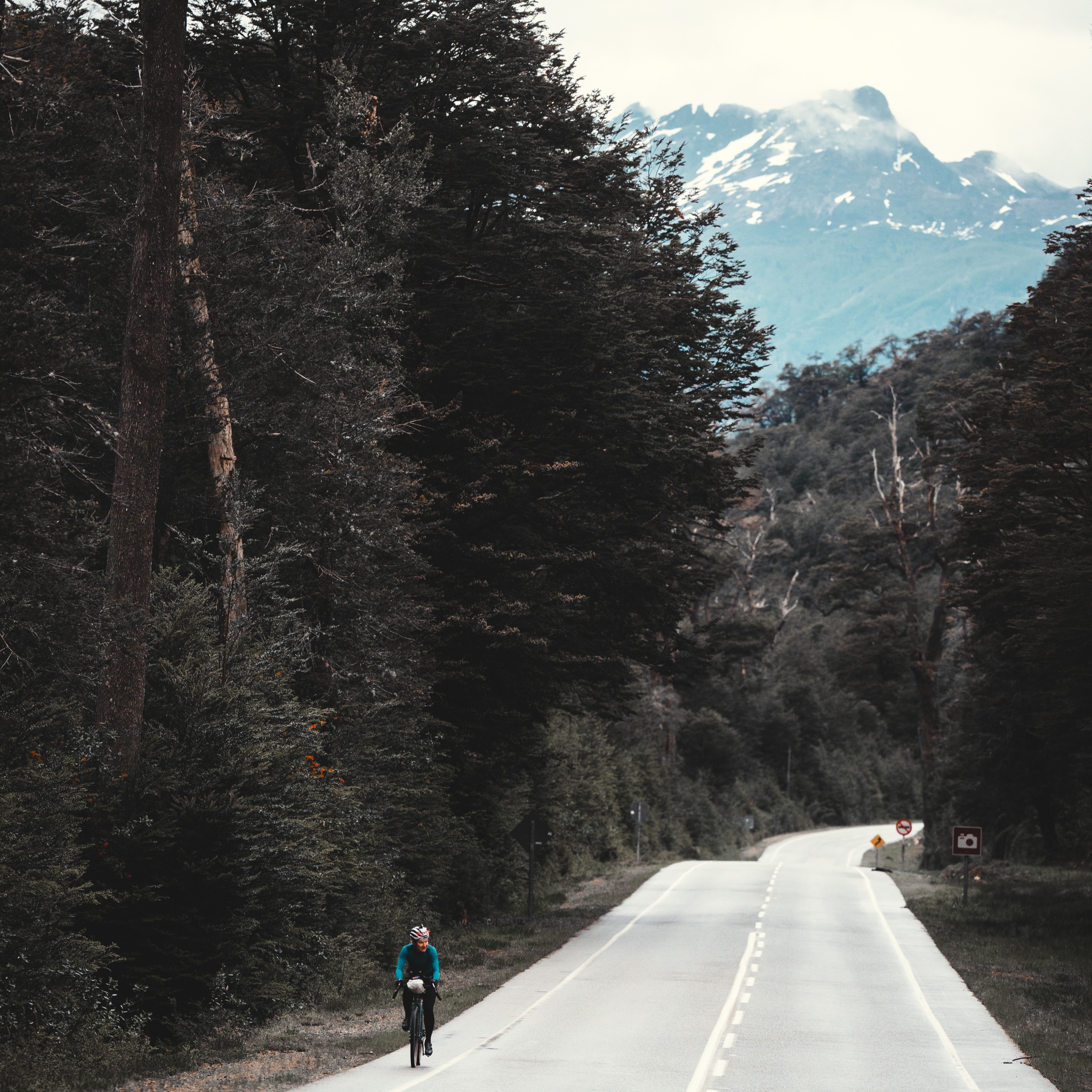
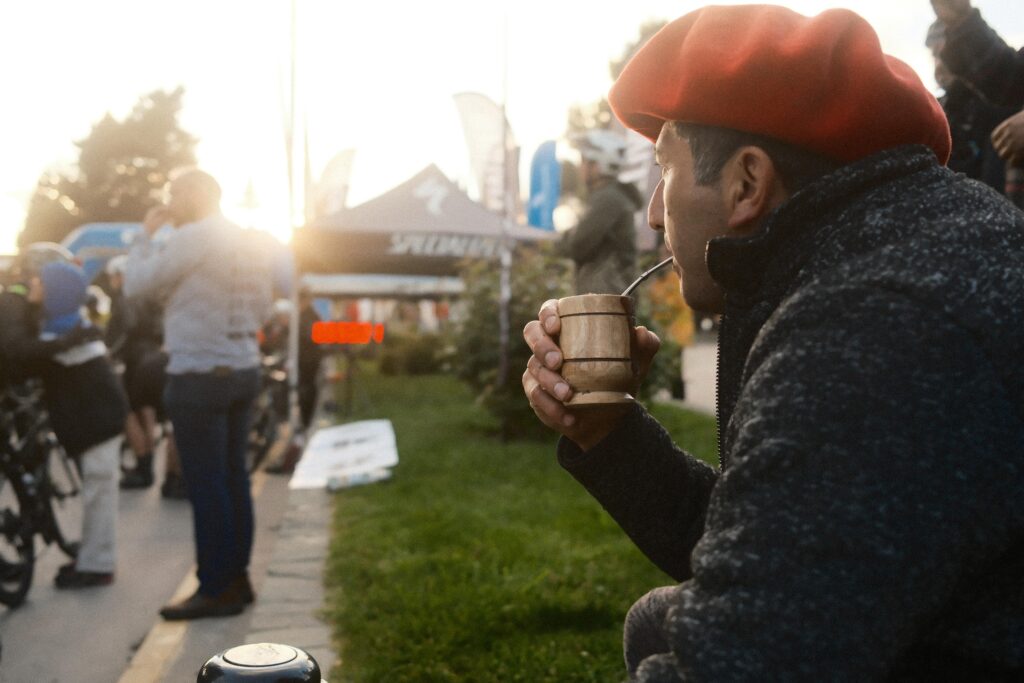
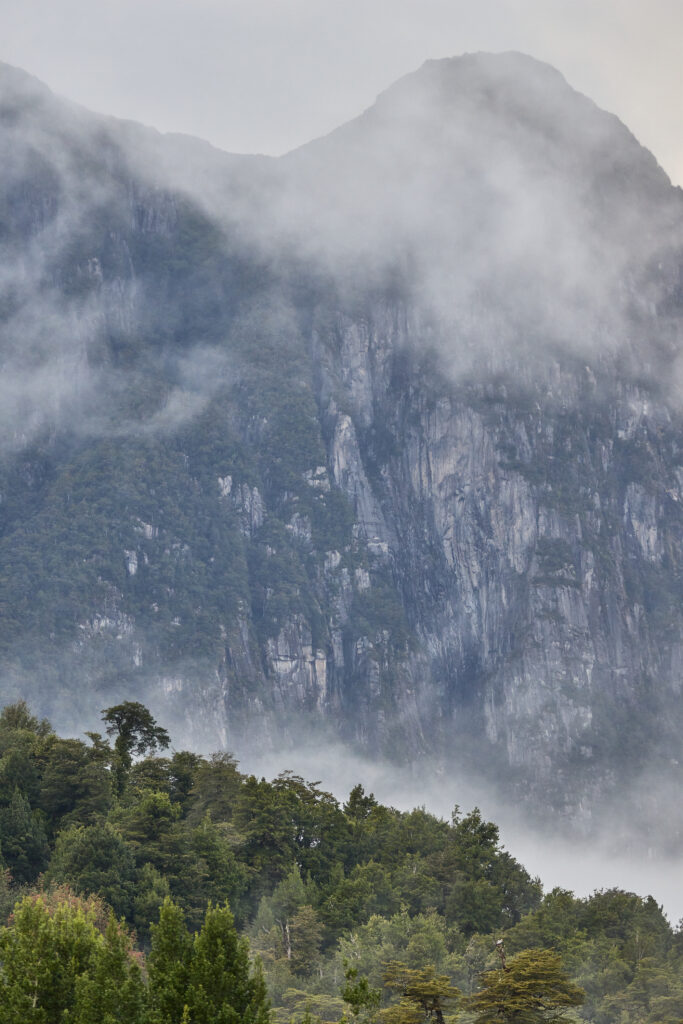
Golden sunlight filtered through the morning fog as 166 racers gathered at the foot of the Andes in the small Chilean town of Coyhaique. This is Across Andes – a 1,000 km (595 mile) self-supported gravel race that weaves through Chile’s diverse landscapes. The 2024 route spotlighted the fjords, rainforests and dry high altitude grasslands of Northern Patagonia. A small group of locals and supporters sat in the town plaza, periodically refilling their Yerba Mate gourds from thermoses of water while they waited to see us off. I had traveled to Patagonia from my home in Seattle, initially drawn by pretty pictures of the route from Instagram. But heading into an unfamiliar mountain range on the longest race I have done yet offered another, more tantalizing opportunity: A fresh opportunity to demonstrate the person I believe myself to be. I didn’t know what challenges I would face over the next 595 miles, but I resolved to meet them with determination, curiosity, and an interest in learning more about the Patagonian wilds and the people who live there.
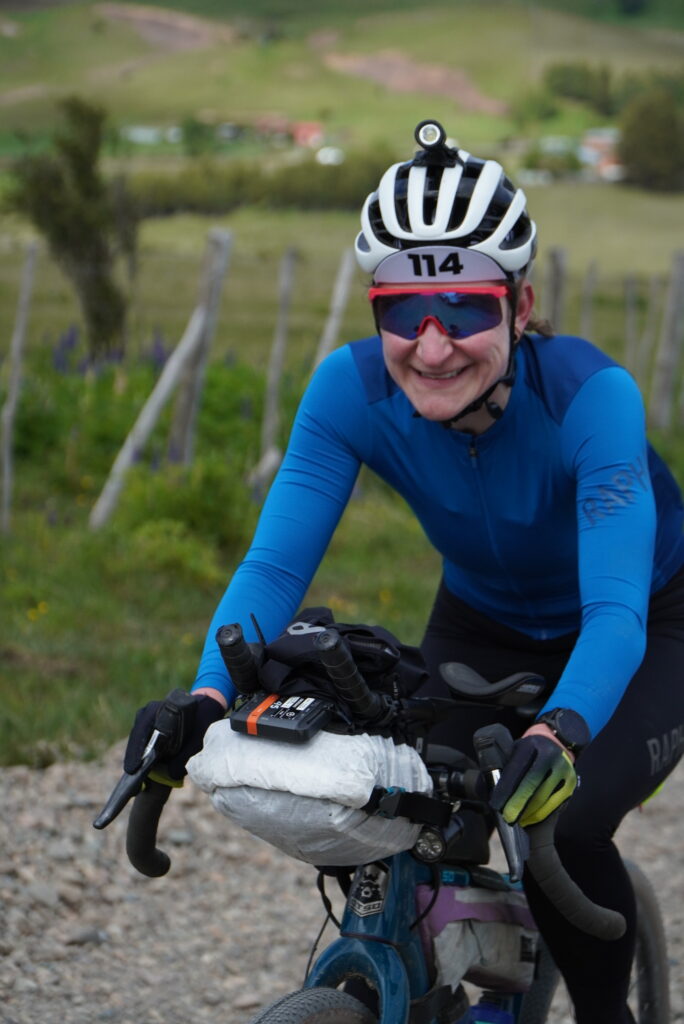
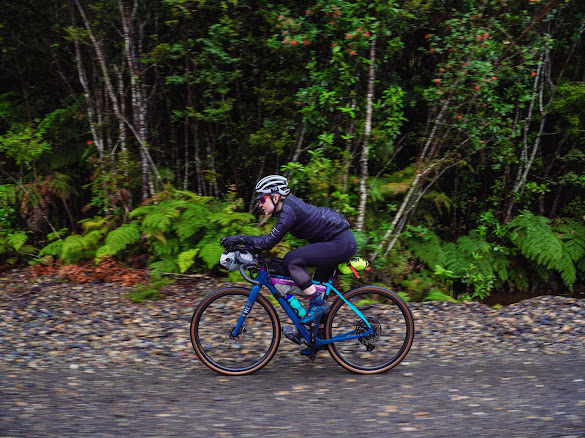
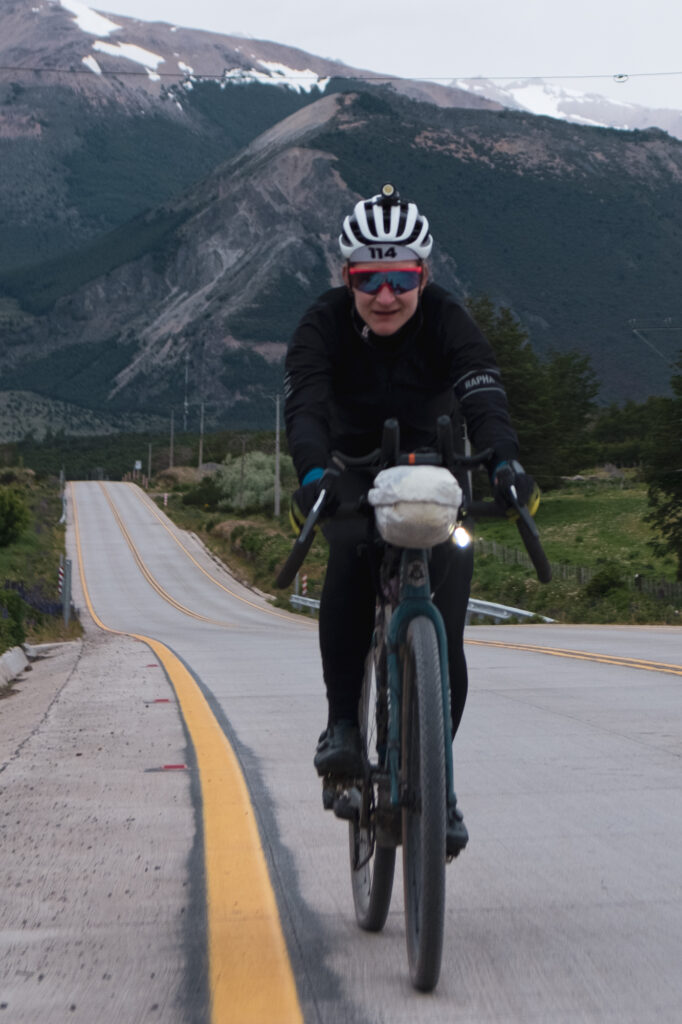
Despite being in a foreign country with a new collage of languages on the start line, the feeling of calm on the start line was familiar. After months of preparation, there was nothing to do now except ride! Most of my kit was also familiar to me. The Otso Waheela C had already carried me thousands of miles in 2024, from cyclocross races, to forest roads and bike packing events. I dialed in the build for 595 miles in the Andes with a 10-50 tooth mountain bike cassette in the rear and a HiFi Cycling dynamo wheel for long nights in the mountains. A custom LOAM Equipment dry bag under the aero bars held layers and layers of clothes I could recombine to face the huge variety of weather that the Patagonian spring can dream up. Other than that I packed light, carrying just an emergency bivvy and counting on a modest cabana we would pass at mile 261 and 431 of the course for rest.
Photo by @ChoikeBags
The first 100 miles of the course presented the clearest physical challenges, but with fresh legs and stunning scenery it was easy to tackle them with a smile. These are the kind of challenges you can see on a course map and prepare for: a jagged saw tooth climb that began as soon as we left the town of Coyhaique, climbing a total of 9,200 feet to the Argentine border, with few opportunities to resupply or filter water. The highest point of the route was at mile 100, before plummeting down through through Check Point 1 at mile 115.
Other challenges stemmed from the unique geography and climate of Patagonia. Coyhaique is nestled in a valley with fairly temperate weather. Giant rock faces buffer the valley from Pacific rain storms from the west and the winds of the dry Argentine grasslands, known as the Pampas, to the east. As we climbed out of the quaint little valley drenched in fragrant purple lupine flowers, sheep farms and forests of wizened pine and Araucariatrees gave way to giant swooping hillsides covered in dry golden grass and the occasional llama.
In the valleys, farm houses and trees provided a reference point for the tremendous scale of the mountains around us, but in the open Pampas it was nearly impossible to guess how long the slope in front of me lasted. I reached the high point of the route around 3pm, but I only had a few moments to revel in surmounting my first challenge. As I turned the corner and a blast of wind hit me in the face – what looked like a rip-roaring descent turned out to require carefully navigating gusts of winds over 30 mph that alternately pushed me against the cliffs to the side of the road or hit me so hard in the face that my cheeks blew open like a windsock. The pampas landscape clearly showed the power of the wind. In the valley below me, I could see huge piles of dirt blown up against rock chimneys and buttes that had been scoured bare by the wind. Falcons played in the gusts high above but no other life was present expect a few little dots of cyclists far in the valley below.Photo by @EvelinBuhmann_
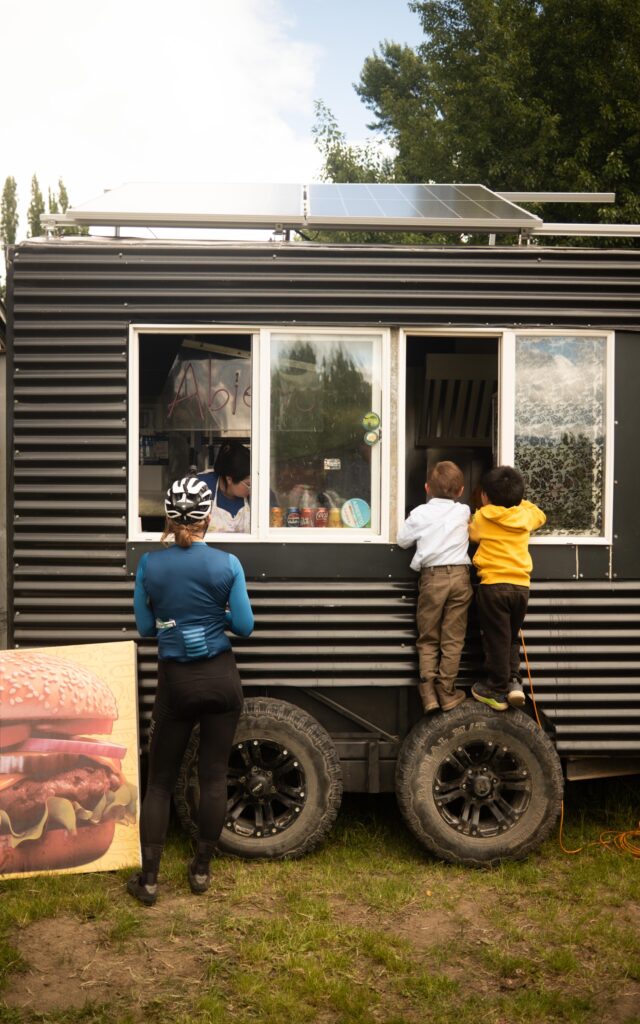
I caught up with a few other racers in this section. It was incredibly tempting to stick together to battle the wind a little bit more efficiently. As with many ultra endurance events, the Across Andes definition of ‘self supported’ disallowed any drafting. The first check point was at Estancia Ñireguao, a historic farm nestled out of the wind. The Pastoral scene was in stark contrast to the cliffs of the pampas. A few young kids cuddled with puppies in the green yard, their mothers watched them two little stands selling sandwiches and snacks. A few cyclists lay resting in the grass or leaned up against the weather barn with huge sandwiches. I only realized once a gaggle of photographers ran up to me that I was the first woman to pass through the checkpoint! Loading up on food, I was very happy to acquire four sandwiches filled with caramelized onions, mayonnaise, and any other vegetarian toppings that were available to break up the monotony of gels and gummies. I strapped three sandwiches to the top of my aero bars and headed out to face the wind again.
Photo by @EvelinBuhmann_
As the bumpy road wound further into the mountains and out of the wind, the Pampas gave way to scrubby pines and more lupine. Descending a rough stretch of road my bungee snapped through one of my precious sandwiches and sprayed caramelized onions and mayonnaise all over my bike and I, leaving onions caked on to my frame for the rest of the race. At mile 145, I turned on to the Carretera Austral – the partially paved road that provides the only connection to the little villages in northern Patagonia. I was making good time on the paved road, but as I refilled water in the home of an incredibly welcoming family in Villa Amengual around 10pm a woman shared ‘There is nothing between here and Puyuhuapi (55 miles ahead) but mountains and rain’. There were still 80 miles between me and the cabana where I planned to get a few hours of sleep, and my mind obsessively questioned whether I had been overly ambitious in planning to ride 260 miles through the Andes before resting.
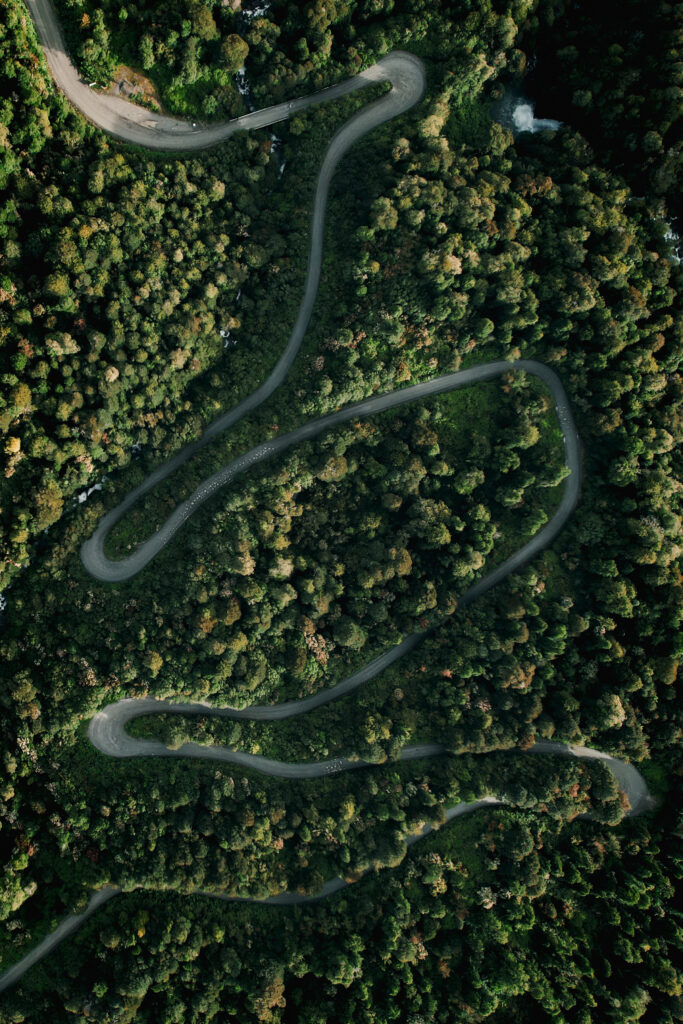
A group of three cyclists coalesced as we headed in to Parque Nacional Queulat. We updated each other on our slow approach to Cuesta Queulatin a broken mix of Spanish, English, and Portuguese. The steep switchbacks of Cuesta Queulat climbed 1500 ft in just 4 miles, a clear land mark even in the pitch dark. My company fell away as we started climbing up the switch backs. In the dark forest, anything behind you disappears immediately around the next hairpin turn.On the other side of the climb, the temperatures dropped quickly as I descended towards the Pacific fjords.
I finally made it into the gas station at La Junta, the little town where I had found a place to rest, around 4 am, in sixth place. Four of the men in front of me had recently arrived at the gas station and were groggily fiddling with their rain gear and stuffing food into their bags with numb hands. Almost as soon as I stopped I started shaking uncontrollably – hypothermia was a real possibility and It was a huge relief to have a place inside to sleep! I dragged my muddy body under the covers with two gas station sandwiches and looked at the GPS leaderboard for the first time – Cynthia Carson, the second place woman, was 80 miles behind me. She is incredibly strong, and thrives with minimal sleep, so I knew I would lose my lead if I slept for more than two hours. I set an alarm and dozed off with a half eaten sandwich in my hand.
Photo by @CDiazPhoto
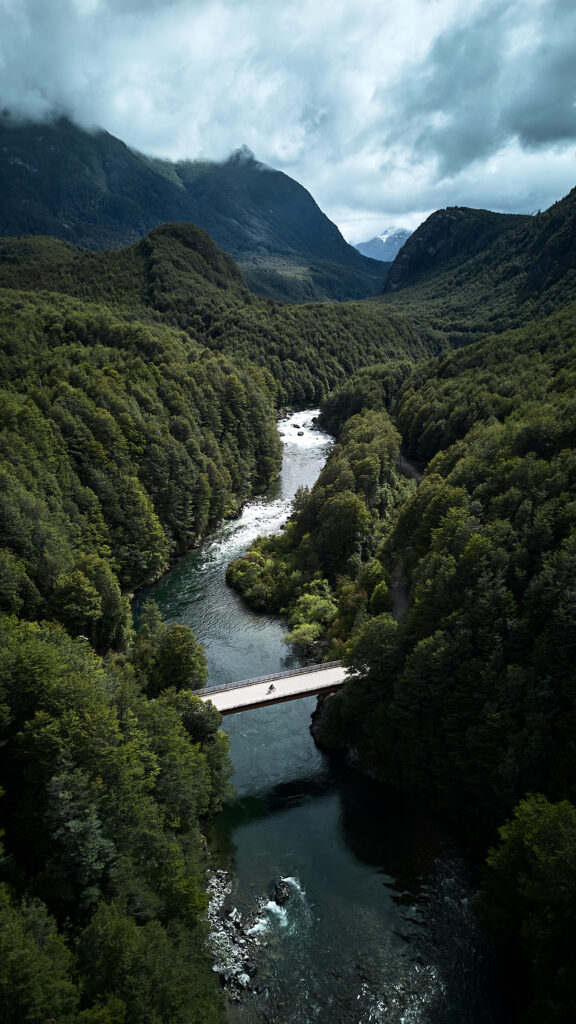
When I woke up there was a weak grey light filter in the windows and the dogs barking outside were almost drowned out by morning birdsong. I chugged two cokes and choked down some gas station muffins still huddled in the covers. Breakfast of champions! I yanked on layers of dirty wet spandex and started my day. It rains 11 to 13 FEET a year in the fjords of Patagonia. When I looked this up from my couch it was described as ‘lush’, but 300 miles into the ride it was honestly quite dreary. The 80 mile out and back to check point two looked flat when you viewed the elevation for the full course, but it was actually a series of jagged little climbs. Road construction and the constant rain made some sections muddy and slow going. I did my best to focus on the things around me and find some beauty or at least distraction in them – the giant nalca leaves up to 6 feet across that hemmed in the road, the mystique of peaks peaking out behind the clouds, and two tiny little ‘pudu’ deer that ran across the road. On the way back, I past Cynthia – she was now just 30 miles behind me.
Photo by @Efezetart
The route past through La Junta again before climbing up 4,300 feet to Check point 3. During the steep ascent, rain slowed just enough for puddles to coalesce into mud and splatter all over me. As I was climbing, my bike computer froze and I was stuck staring at a screen showing me tantalizingly close to the top of one of the route’s 127 climbs. As I climbed the rainforest began to fall away, and the course ran through drier mountain farms. Tiny little homesteads and slap shod barns peeked out behind giant boulders. Vertical rock cliffs framed the rocky fields. And finally, the rain stopped!
Checkpoint 3 was in the gym of the tiny town Lago Verde. In the center a group of cyclists huddled around the most amazing portable heater that blasted hot air, drying even the soggiest of socks. Local abuelas had set up a line of tables and were selling huge plates of pasta, vegetarian burgers, and stacks and stacks of homemade cookies and cakes. After a meal and a huddle around the wonderful heater, I headed back down the mountain. The clouds had lifted and my Waheela navigated the potholes and ruts smoothly, allowing me to take in the beauty of the setting sun glancing off alpine lakes and cliffs during my descent.
Photo by @CDiazPhoto
I leapfrogged with Rama from Australia on the way down, and we shared happy remarks about the amazing scenery. With a positive outlook and just a few rays of sunshine, the next 200 miles, which were largely paved, seemed easily surmountable! We went through La Junta for a third and final time. I dashed into the same room just as it started to pour and slept fitfully for an hour, and then checked the gps tracker. I was relieved to see that Cynthia had stopped to nap at Checkpoint 3. I slept deeply for another hour before heading into the dark early morning drizzle, maintaining just a 20 mile lead over Cynthia.
After buying a half dozen more candy bars at the COPEC gas station and leaving the incessantly barking dogs of La Junta behind, I was alone with nothing but my thoughts. Finally, my computer restarted – then flashed a message that my third and final spare derailleur battery was low, and I had no charger for it. My mind was spinning trying to think of how to carefully mete out the remaining charge for the next 150 miles. The climbs were rolling and the roads smooth as the route wound around the Puyuhuapi fjord, so it was easy to avoid shifting and soak in the views that I had past in the dark on my way there. When I reached the stacked switchbacks of the Cuesta Queulat I stood out of the saddle and forced the pedals around for as long as possible before shifting down again, obsessing over every click. Then my Garmin died again, and refused to respond to charging or any combination of buttons.
I was able to use my back up navigation on my watch for a while – but that died before the finish as well and I hadn’t brought the specialized cord I needed to charge it. With no way to anticipate the next climb or check the other racers’ positions, it was truly an unsupported race. I powered on as there were no turns until we were back in Coyhaique, almost 150 miles away and long stretches of the Carretera Austral don’t intersect with so much as a jeep track.
Photo by @SebastianSamek
I tried to focus on the fields of wildflowers that filled the wide valley left by Rio Mañihuales but my sleep deprived mind cycled between obsessing over the slow failure of all of my electronic devices and trying to guess how much further I had to go. I didn’t see of the Across Andes media cars or another cyclist for almost 100 miles. Suddenly, Leo from Brazil turned the corner in a tiny little Fiat Uno that had miraculously made it over the Andes. He jumped out of the car and to cheer me on. I tried to explain all the troubles I was having but (probably for the best) my complaints got lost in translation. He responded with even louder cheers, pulling out his camera and narrating how fast I was going even as he easily jogged alongside my bike. Leo’s energy carried me through to the next resupply. I filled my pockets with candy bars and pulled out my phone to check the distance remaining.
I had just 80 miles till the finish, and only had to remember two turns after getting back into Coyhaique. There was just one 3,000 ft climb remaining, which topped off ten miles from the finish. I was trying to keep track of the distance by the landscape, but each time I thought I had reached the top there seemed to be one more little kicker. The racer who had been in seventh place passed me on the umpteenth false summit. I managed to hold back tears from my sore knees and strained mental limits until he was over the crest of the next hill.
Photo by @RawCyclingMag
The descent into town was hardly the relief I was waiting for. The busy gravel road was wide enough for four lanes of traffic, with alternating stretches of painful washboards and deep gravel. Six miles from the finish I finally hit pavement and I started crying again, this time from joy. I could see the Rio Simpson valley and the outskirts of Coyhaique spread out below. Coasting in to town, gingerly trying to balance myself on the bike to avoid saddle sores and tender joints, I managed to miss one of the two turns I had to remember. The racer who had been in eighth place passed me and I realized my mistake, and was able to follow him to the finish.
A small group gathered and cheered me in – my now fiancé with a huge bouquet of white roses and champagne, the race organizers Paulina and Mariano, and few other racers unsure of what to do with themselves now that they had finally gotten off their bikes. All of the struggles from the last 595 miles seemed to melt away and I was filled with gratitude for my body, the 2 days, 13 hours and 34 minutes spent in such an awe inspiring landscape, and of course for my final derailleur battery hanging on almost to the end of the race!
I discussed my record setting win at the 2025 Gravel Worlds Long Voyage 300 mile race with Sofia and Jason, race organizers and two absolute gems of humans.
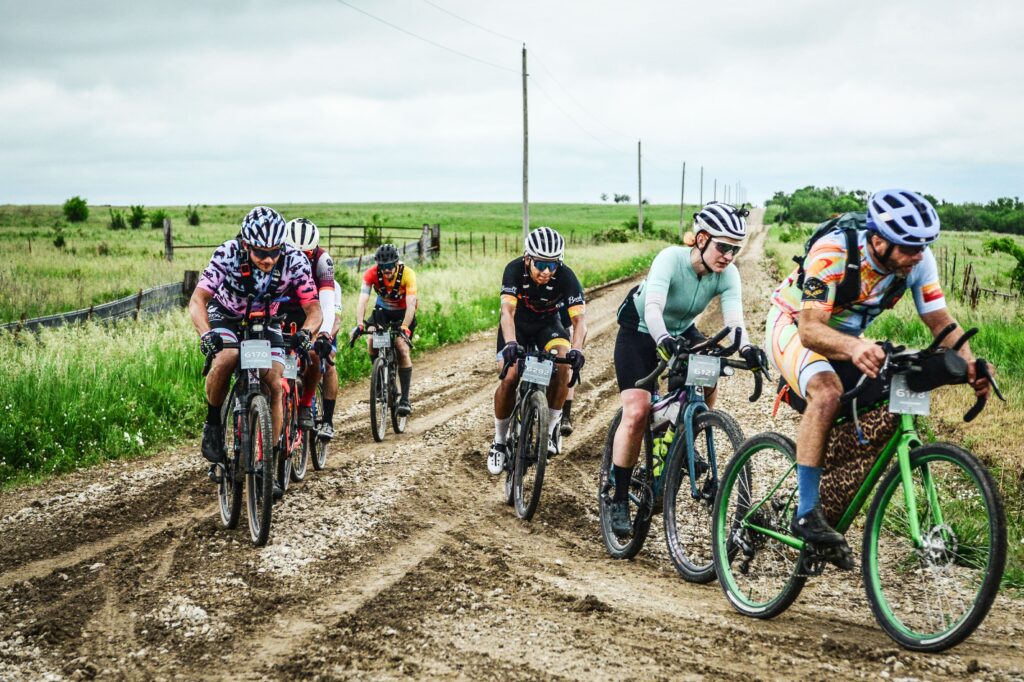
On the last Friday of May, an odd coalition of 192 cyclists packed Emporia’s main street for the 355 mile Unbound XL with a range of equipment ranging from ultra-light to ultra-prepared. The camera crew hovering in a helicopter above us was in stark contrast to other bikepacking races I have done, which by and large start on remote trails without much fanfare. After months of preparation, it was a relief to hear the starting gun fire. I had obsessively prepared for this event for months, and finally I could stop fretting about my packing list and training. There was nothing to do now but high five the spectators lining the road and pedal!
It was difficult to hold a steady pace as we headed out of town. No doubt there was a strong pack at the front who were traveling at an endurance pace, but my heart pounded in my chest as I prepared to test my gear and training. We headed out of town and quickly hit dirt. Within a few hours the lead pack pulled ahead, enveloped in a cloud of dust. I settled in at a more comfortable pace with eclectic little pod including Jan Heine on a steel canti bike, Jesse from Jersey with a bleached mohawk and neon pink kit, Nico on a single speed, and a mechanic who talked about the terrible mechanical damage mud at Unbound does for at least an hour. The first resupply stop was unassuming gas station at mile 86. The bustling interior drew a sharp contrast to the quiet Kansas plains, with at least six photographers buzzing around the racers.
Artistic Emages
As we passed the hundred mile mark, the sky grew dark. I was feeling strong and my Waheela C with 2” tires allowed me to fly confidently down a series of minimum maintenance roads, eventually pulling away from our little peloton. Soon it was just me and Marcelo from Chile facing the dark plains. We stopped at the resupply in Alma for Coca Cola and Haribo. The mood was distinctly different, with several folks sprawled out in the parking lot looking concerned about the many dark miles ahead. The night erased any landmarks except for the dips of small creek crossings and dogs barking with varying degrees of ferocity. As I shifted down to climb out of yet another streambed, my chain over shot the cassette, slingshotting into the wheel and breaking a spoke. With little to fix it besides a wing and a prayer, I carried on. Around 3am Marcelo and I caught up with Ivy. The three of us carried on past yet another set of barking farm dogs, doing a sad impression of a sprint as one of them wriggled free from its fence and nipped at our heels until the end of the property. By the time light was peaking over the horizon, one of my lights was fully dead and Marcelo and I were taking pulls, with our lights in the lowest setting while someone else was in front to squeeze out a few more minutes of light from our batteries.
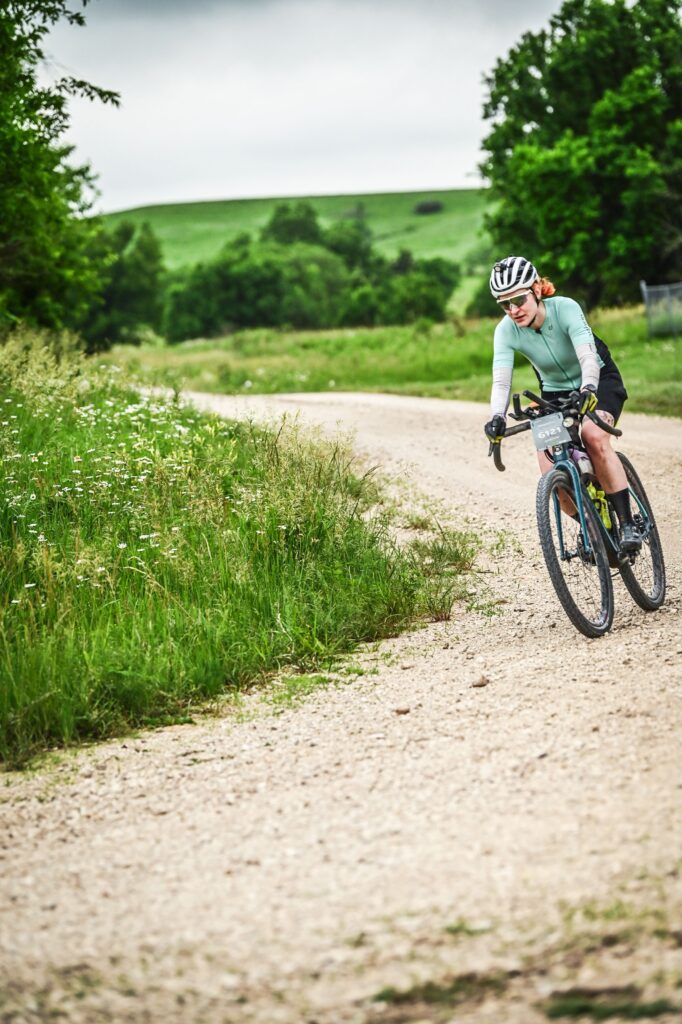
The mysterious night dissolved into a rather mundane morning as I pulled into Council Grove (mile 219) at 6 am. I rushed around the gas station trying to top off water and snacks for the next seventy miles of my adventure, while locals stopped by to pick up a coffee and head about their usual business. The cashier had already seen dozens of haggard faces come through and barely looked at me twice as I fumbled with my dusty wallet and tried to remember usual niceties. Good company seemed less essential in the pale sunlight and our little squad broke up. I was feeling good – amazing considering the sleepless night and 250 miles under my belt. The weather seemed custom tailored to my PNW training: a protective foggy coating hid the sun, and the light mist that would have been refreshing if I hadn’t already heard so many horror stories about the mud south of Emporia. The little rolling hills were blanketed in a bright spring green which carried on as far as I could see in any direction.
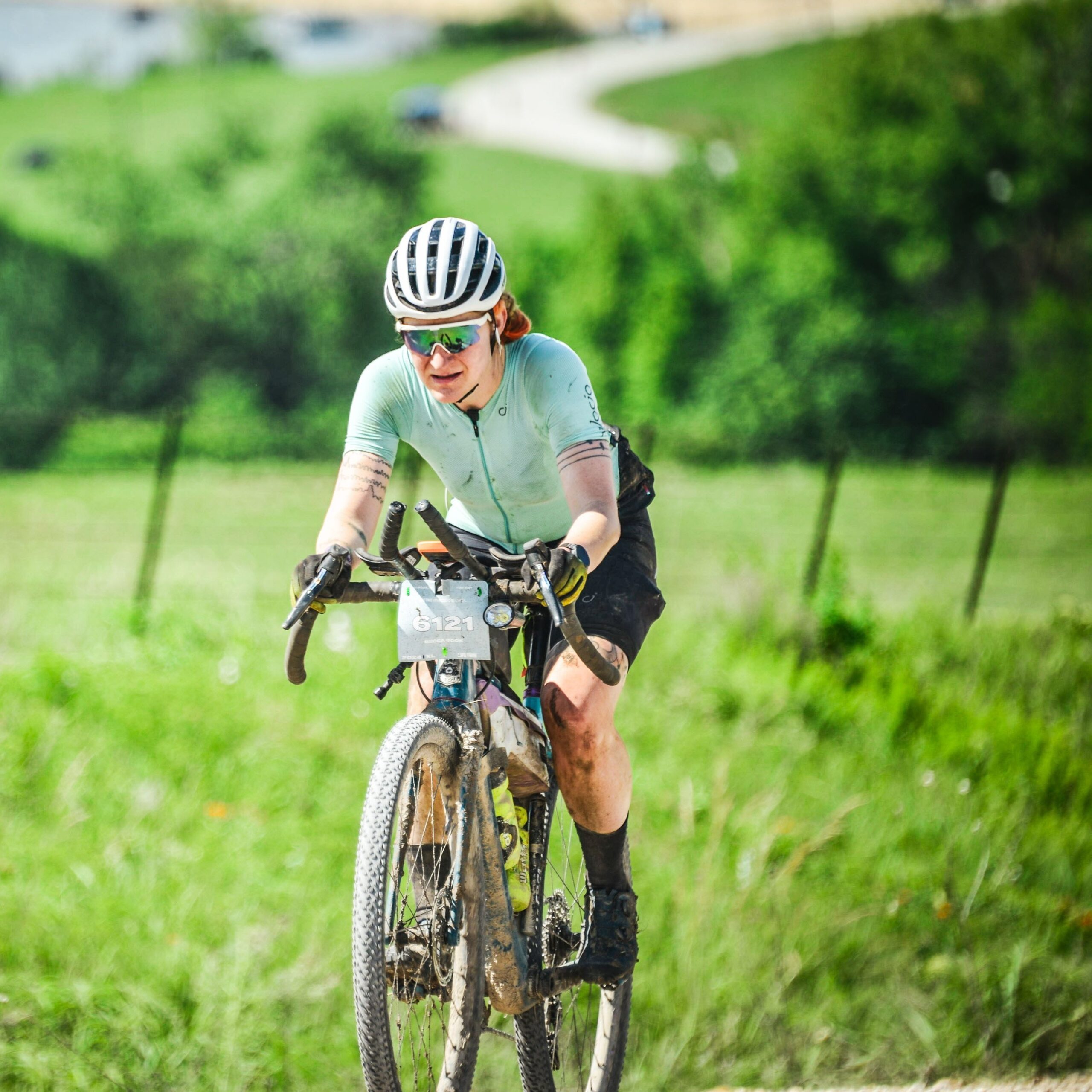
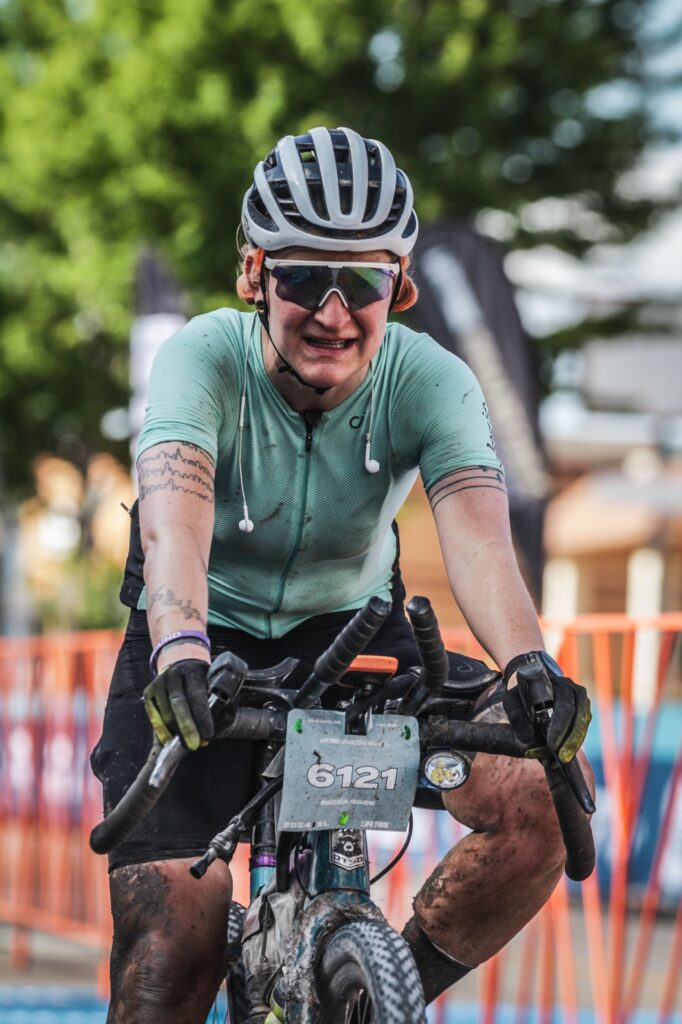
When my wheels stopped rolling, it barely even registered what happened. The road in front of me looked smooth and dry, but just ahead of me I saw the little dot I had been chasing off their bike as well. We had hit mud, and within seconds inches of it had caked onto my wheels so thick they couldn’t even roll forward. I scraped it off meticulously with a brush I had packed for this exact moment, but my ample tire clearance clogged up just as fast the second time. After several minutes of dragging my bike behind me my race-addled brain realized that I should be walking in the grass. This was an imperfect solution, because every hundred feet or so the drainage ditch on the side of the road merged with a natural stream from the neighboring field, forcing me back into the mud.
At some point Marcelo trudged past me shouting the dubious advice ‘You just have to keep moving!’. I ended up with two other men who were equally as confused as I was about how, exactly, to keep moving. We veered a few feet away from the road before we realized we were on the wrong side of a barbed wire fence along with a farmer’s pit bull. We helped each other lift our bikes, now heavy with a thick coating of mud, over the fence. Just a few feet ahead was the crest of the hill… and dry road! I tried in vain to clean my bike, focusing on the space between my frame and my wobbly wheel, which was quickly shrinking due to the broken spoke.
Despite my best efforts mud still clung to my chain and weighted down my bike, and being back in the saddle was not the panacea I had hoped for. I called my partner, Brandon, next to tears, with the thoughtful insight into race dynamics ‘This is REALLY HARD!!’. The support that trickled in over the phone over the next few hours revived me in a way I couldn’t have even anticipated. Brandon had been up since 4 AM Seattle time watching my dot progress on trackleaders and messaging with friends. He shared that I was in an apparent second. Svenja Betz was off the front on a record setting tear. Cynthia Carson had pulled out, treating a potential concussion with well deserved caution, which was rewarded with a speedy recovery. Ivy Pedersen was ahead of me but appeared to be off course, following an outdated course file. Meaghan Owens and Kait Boyle were just behind me, working together to close down the gap while I had a cry on the side of the road.
I had a goal to work towards now: A podium spot. But more than that our call helped me shift my perspective from my muddy bike and aching back to the whole community cheering me on. As the race heated up and the day’s temperature soared way past my comfort zone, cheers came in from my family in Atlanta, friends from Emporia to Seattle to Chicago, and strangers who spent the whole day waiting along shout a few words of encouragement to increasingly ragged XL riders as they passed by. After a couple of ibuprofen and handfuls of muddy Haribo, my tears turn from sobs of self pity to tears of joy for all the support I was getting. I sunk into my aerobars and hammered out the final stretch. Thirty miles from Emporia, we rejoined the daytrippers – just as the elite women raced past me into town! This was the first year the elite women were granted their own start at Unbound, and the front row seats to a history-making race distracted me from my own aches and pains for several miles. I wasn’t going to let myself stop until I was across the finish line, and there was no way to get there but gummy bears and pedal strokes. Messages of support were popping up on my computer every couple of minutes, but I was getting a different type of message from my bike: ‘Derailleur battery critical!’ and a squishy rear tire to match the wheel’s wobbles.
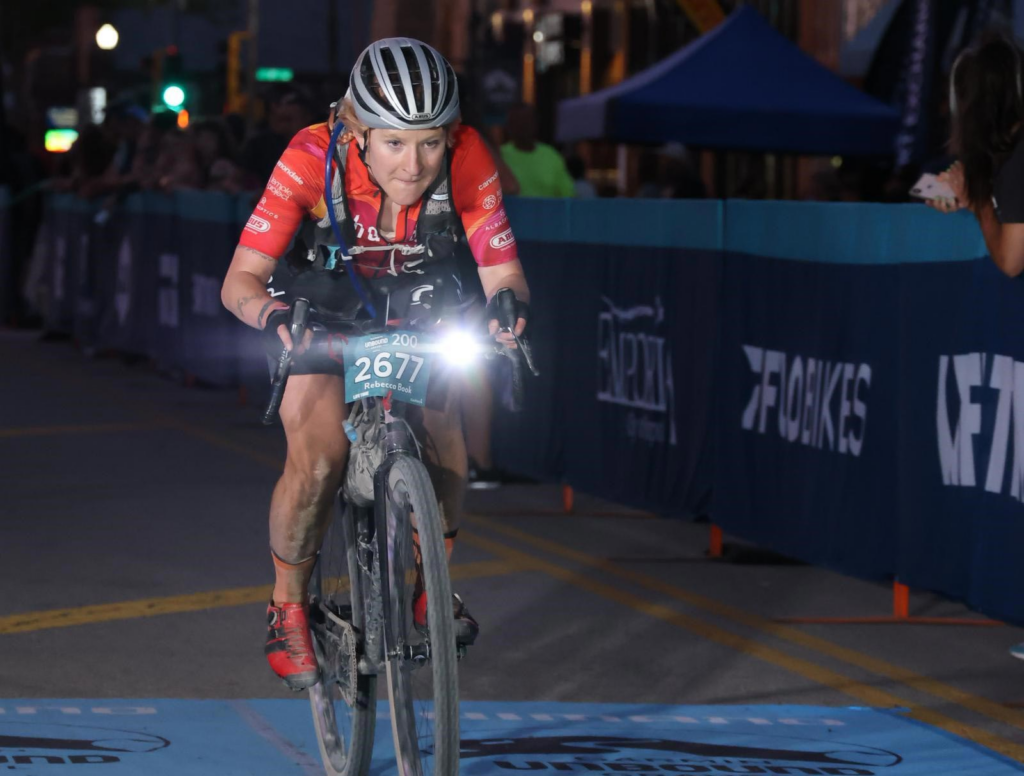
Then, it was all done. I was standing, dazed, in the middle of Emporia’s Commercial street. There were photographers, families enjoying the fair-like atmosphere, and kids eating popsicles, and not a trace of the mud and prairie I had stared at for 26 hours and 37 minutes (well, except for smeared across my body and bike). All of the training and fiddling with the setup on my Waheela had paid off, and I managed a third place finish. Kait followed quickly behind just 2 minutes and 48 seconds behind me, finishing with a smile even after riding over one thousand miles to the start line. Meaghan was just 13 minutes behind her. Ivy’s final race time put her in second, just 2 minutes and 15 seconds ahead of me. It was a shockingly close finish for a 354.5 mile course. It invigorated even my leaden legs to find such fierce competition in the women’s field in an ultra endurance event. My friends Marley and Makenna shepherded me into the shade and took my bike to get washed. One of the owners of a taco stand saw me sitting on the pavement and brought me an agua fresca. Two taco bowls later, the saddle sores and sore legs seemed irrelevant, and I was left feeling awe and gratitude for the supportive community that cycling has helped me find.
The Dark Divide 300 is a challenging mixed-terrain route traversing the expansive ancestral lands of the Squaxin Island Tribe, Nisqually Tribe of Indians, Cowlitz Indian Tribe, and Confederated Tribes of the Grand Ronde through what is known commonly as the Southern Cascade Mountain Range in Washington. Find a recap from three participants of the first annual grand depart here…
Frame Grabber 1.5.6
Words by Becca Book (3rd place overall, 2nd place women), Katie Smyth (7th place overall, 3rd place women), and Raasika Gaugler (15th place overall, 6th place women); photos by various participants
On an overcast Thursday in early August, a group of 27 cyclists gathered in Squaxin Park with an intriguing mix of bikes, each reflecting their personality. They were color-coordinated and loud, home-made, and custom-curated. A full third of those on the starting line were WTFNB riders, thanks in large part to three years of thoughtful community building by race organizer Ben Everett.
At 7 a.m. sharp, the group rolled out, riding “into the trees, into the trees” as the trail anthem “A Forest” by The Cure directs. The first 28 miles follow a smooth multi-use trail, allowing time to build connections between riders before scattering into the remote Dark Divide Roadless Area for which the route is named. Riders exchanged familiar greetings: “Did I pack enough snacks?”… “Maybe I packed too many snacks?”… “How many snacks are too many?” With each pedal stroke, the anxiety fades and is replaced by a shared desire for adventure. The transition from the city to mountain, from group to alone, happens in increments. The first group sprints ahead. They will ride through the night.
After the small town of Eatonville, the route reaches the first gravel climb. The steepest part is at an opening in the forest with tall trees and purplish-pink flowers. Breathtaking scenery accompanied by brutal climbs is a recurring theme on this route. Pacific Northwest routes often follow logging roads, which the Department of Natural Resources will tear up once the prime slices of lumber have been logged. The road clambers over a half-dozen boulder piles placed to let everyone know there are no more trees worth logging before descending down a smooth road into Packwood. To the left, rugged cliffs frame the first views of Tahoma (Mt. Rainier).
Packwood is a full-service town and offers riders the last creature comforts before winding deeper into the Gifford Pinchot National Forest. The route winds through the fertile valley carved by the Cowlitz and Cispus Rivers to an unmaintained road dotted with fallen trees, debris, and a series of gravel washouts to duck and dodge through. Success is rewarded by a 5,000-foot climb to Juniper Ridge.
Juniper Ridge is crowned by a mountain bike trail that quickly becomes too steep and powdery to ride, with grades reaching 40 percent. It’s hard to even hike, forcing riders to tackle the trail through some combination of pushing or shouldering their bikes. Carefully assess where to put your foot, as there is a sheer face to the right that could be described either as an epic vista or a gaping void.
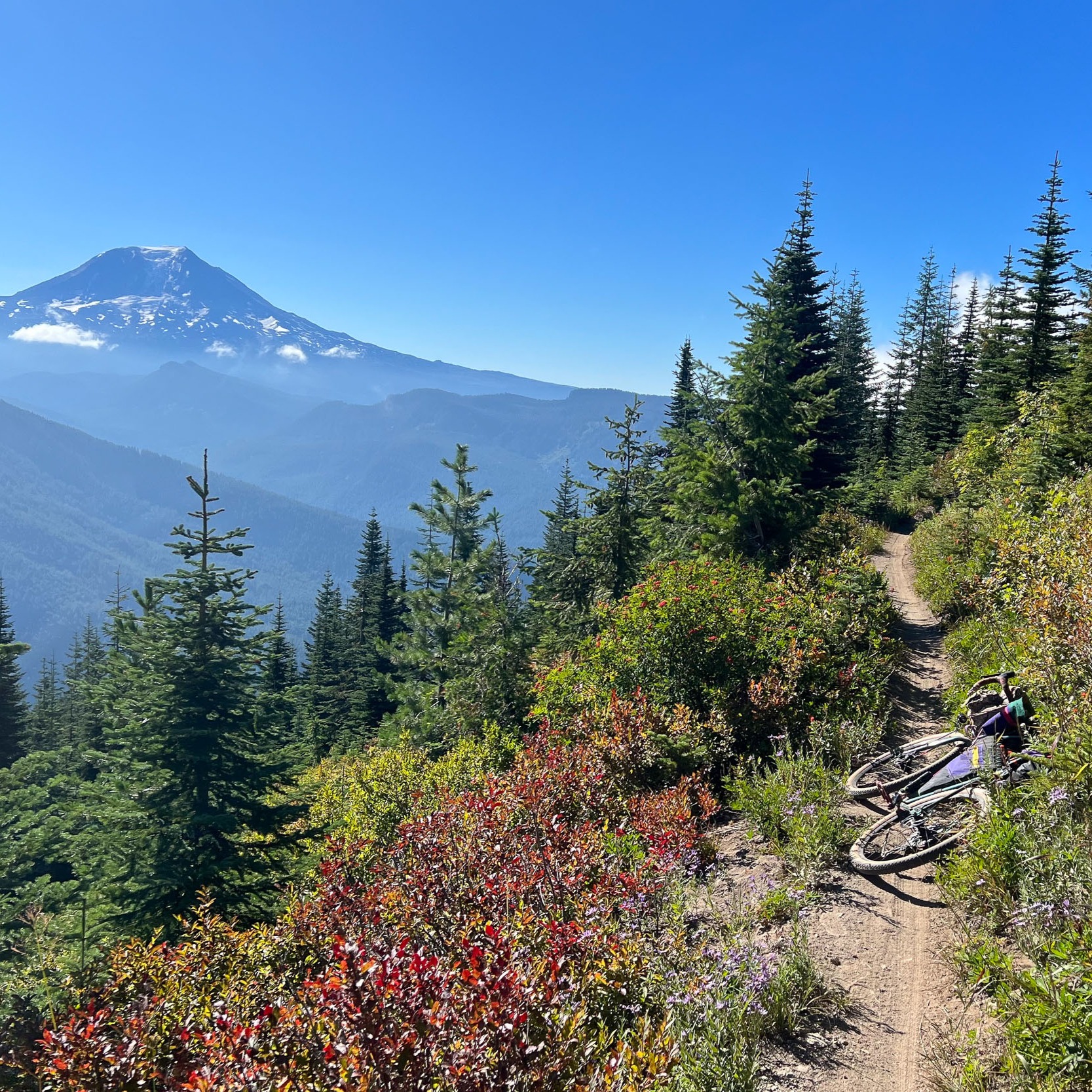
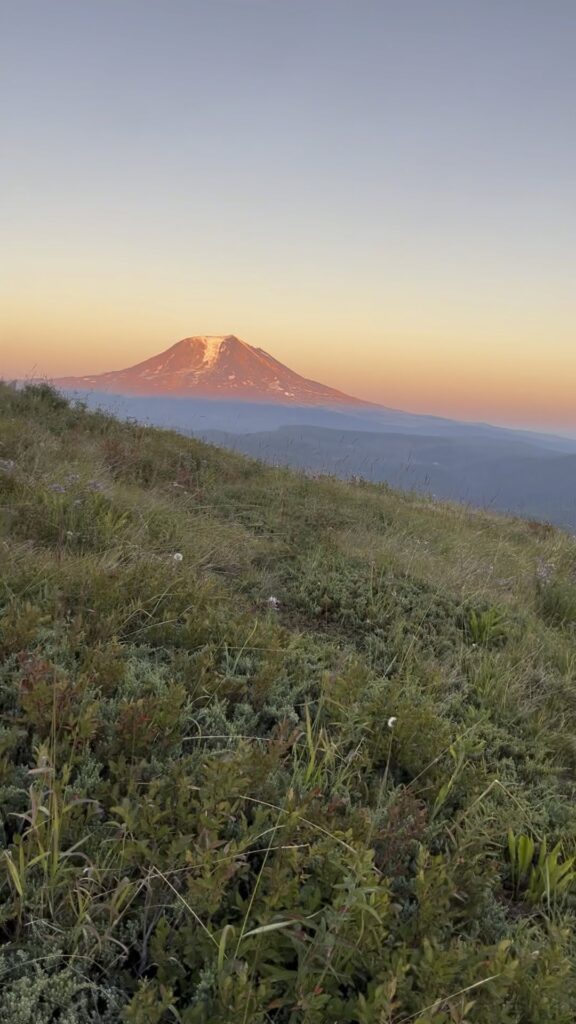
This 2.5-mile struggle leads to an open ridge line with alpine flowers and views of Tahoma and Pahto (Mt. Adams) that float above even the most persistent Pacific Northwest clouds. The sandy terroir, while by no means easy to ride, contributes to a rather pleasant sensation that you are floating down the ridge line. The trail quickly dives into a deep tangle of moto trails that was a mess of hike-a-bike with a few tumbles into the bushes for most racers.
By the first night of the first day of the grand depart, dots were strung along the course from the climb out of Packwood to deep in the Dark Divide, but the darkness made any idea of the distance abstract. Each racer had a similar view of a small section of trail eaten by milky black. The rest of the surroundings blend together into a series of ups and downs, rarely broken by the lights of a passing motorist. One motorist who thinks they are being helpful volunteers that there are cougars in the area. Some of the racers try to nap, surrounded by stumps that look like bears and cougars or any other beast you could imagine in the narrow beam of a head lamp. The weight of solitude is heavy in the darkness, but as dawn slowly approaches, the darkness is broken by streaks of color through the sky, more vivid than our shared hallucinations. The Perseids were peaking that night, and shooting stars lit up the sky above each ridge line.
After what could have been forever or no time at all, the sunrise glows purple through a haze that settles low on the horizon with a few peaks poking through. After nearly a day of solitude, the animals become welcoming companions, and the volcanoes become friends that visit on the horizon to tell you that you’re moving closer to Portland. Tahoma moves behind you, and Pahto grows larger to your left. The ripe huckleberries start to shine in the dawn light, offering an appealing snack.
For those with a more hearty appetite after cycling 200 miles, there is another resupply option at Trout Lake. The little town offers burgers, scones, and an opportunity to catch up on wifi. The route from Trout Lake to the tiny unincorporated hamlet of Stabler is easy, even at night; the few potholes are highlighted in the slow flickering of a dynamo, but you rarely go slow enough for a dynamo to cut out.
Even a hamburger is no panacea to the challenges of the route. The brush grows thicker out of Stabler, eventually growing so thick that it prickles your skin as you ride past. The dense, lush greenery creeps in more and more as the trail gets steeper. A series of ditches make climbing the already chunky terrain even more difficult with a series of off-camber, up-down punches. Each ditch feels like a personal affront, accompanied by a kick in the crotch and a slap in the face from a nearby branch.
The top of the 4,000-foot climb must include an epic view, but a heatwave and the previous 270 miles made it hard to enjoy even alpine flowers and open scenery. The summit offered little beyond smothering heat. When a descent finally came, it was chunky and rough and had lots of potholes. There is no respite until you reach the very bottom, where a river offers a cooling swimming hole that can reinvigorate even the most numb and weary bodies.
The final segment of the race was best narrated by Shania Twain, as heard on a phone speaker: “Let’s go girls!!!” The route starts to descend back into civilization, plummeting down the mountain directly onto the truck route that leads to a bike path sandwiched between four lanes of interstate traffic. Finally, you are entering Oregon! Hands up to fist pump. The last eight miles follow a river path by the airport, which could have gone on forever. You cut across a highway covered in broken grass and pass a line of trailers on the street and are unceremoniously jolted back to everyday life at the finish line, the parking lot of a New Seasons Market.
This route and the people it attracts reflect our shared desires for both solitude and community. Our experiences demonstrate that you can pursue both simultaneously. It takes a lot of people to ride alone: fellow riders to confirm you have the right amount of snacks, trail angels offering cold Cokes on alpine forest roads, friends who open their homes, and organizers like Ben who make it happen and are there to wish you luck at the start. Community will exist because we choose to build it, see it, and appreciate it. It can exist alongside solitude.
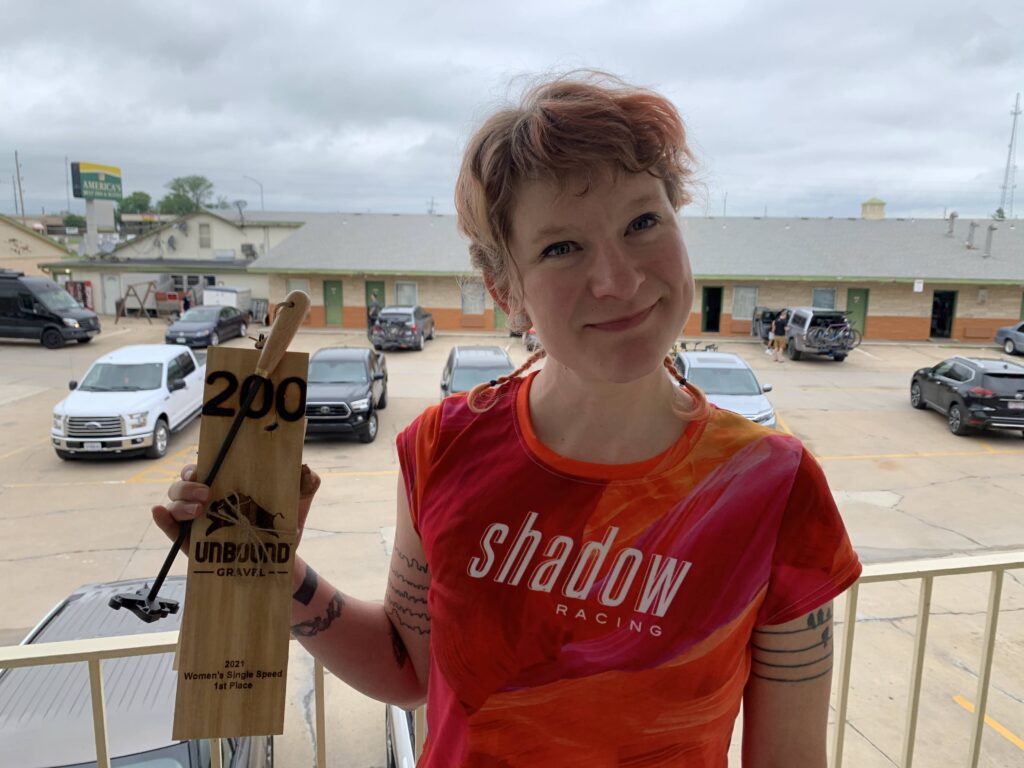
Becca Book looks back at her time in Emporia, Kansas, where she raced a singlespeed on sharp gravel for 206 miles. She raced it to the win.
That’s right-Becca won the Women’s Singlespeed category in the 2021 Unbound Gravel Race! She is no stranger to off-road competition, having secured second place in the non-championship Women’s Singlespeed race at 2019 Cyclocross Nationals, as well as 12th in the Master Women’s 30-34 geared field that year. This big win at the Unbound Gravel Race is an impressive addition to her palmares! Originally from Atlanta, Becca lives and trains in Seattle, Washington. She is a full time designer and builder. When she’s not working or riding, Becca enjoys gardening, working on furniture, and pampering her houseplants and cat. We got a chance to chat with Becca about her journey as an athlete, and to hear more about the road to Emporia in 2021.
Finding the Motivation for 200+ Miles on Gravel
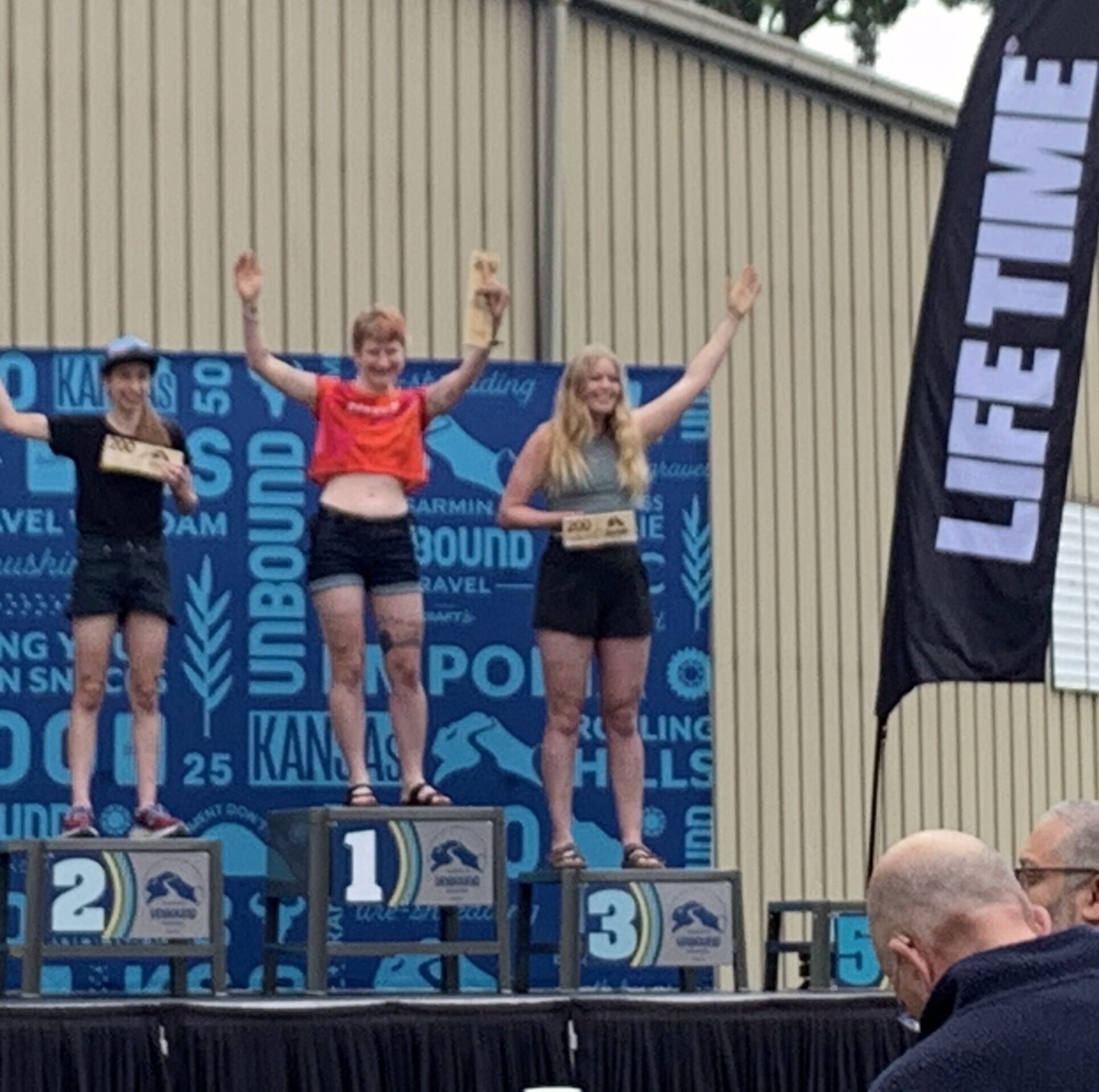
Wenzel Coaching: Becca, let’s jump right in with a philosophical question. This is a challenging event that requires pluck, resolve, grit, and steadfast determination. The readers want to know- What is your motivation to train and compete? Becca Book: It brings a sense of adventure and excitement to a world that can be mundane and predictable. It is also a productive and rewarding outlet for my competitive energy. I like to show myself that I can complete a new caliber of challenge. Becca stands victorious with her hard-earned winner’s trophy! 200 Miles of Gravel Sounds Too Easy? Try it on a Singlespeed WC: Racing the Unbound Gravel Race certainly qualifies as a challenging deviation from routine! What drew you to the unique challenge of competing in the single speed category? BB: I started racing singlespeed cyclocross mainly because the competitors in the category are known for their ability to have a good time on the race course. As much as I want to improve as a cyclist (and I do love a podium pic), cycling is still a hobby for me. Racing in the singlespeed category is a great way to keep things fun and remind me why I love cycling. I also found it was a great way to improve my technique. For example, racing singlespeed teaches you to carry momentum up hills and through corners, because you can’t just brake and then shift down as you approach an obstacle. There is also an equipment side to it. I raced the Midsouth 100 Gravel Race on a single speed in 2020, as many people do, because the mud eats derailleurs. I found that I loved the simplicity of it. The simple drivetrain allowed me to focus on overcoming the challenges of the course without fussing over gear choice and cadence. Unbound has similar rolling hills (but thankfully no mud!) which I actually find cater well to single speed because even though the elevation adds up, you can carry some momentum almost all the way up the hill. WC: That answer will resonate with Singlespeed aficionados worldwide. Let’s talk more about this 200 mile doozie of a race. Can you tell us about your preparation? Preparing for Nearly 15 Hours of Racing BB: In preparation, I did a high volume of low impact endurance training. Consistency was very important. I added a little time to all of my usual weeknight workouts. These were generally one hour and forty-five minutes to three hours in duration. On weekends, I would do at least one long ride, gradually building up the distance. Jess, my coach, helped me find some other women in the area who would be interested in doing long gravel rides. I also did a series of smaller gravel events as stuff started opening up, including some local socially distant “races” where the organizer shared a route and asked folks to send in their completion times via Strava. I also completed a 185 mile race from Colorado to Utah. These parts of my preparation were an exciting way to discover new routes and get back into racing after quarantine. They were also really valuable to dial in my nutrition and equipment. I did most of my training on a geared bike, but Jess suggested workouts to do on a singlespeed. These included drills to improve the efficiency of my pedal stroke and hill repeats. WC: That really shows the level of commitment required to succeed at an event like this. What were some obstacles you faced in training? BB: Time! Jess was super helpful in suggesting workouts that would help improve endurance efficiently and fit my schedule. It was great to have someone to reach out to for advice on how to rearrange training when life got in the way. Mental, Tactical, Technical, and Training Support from the Coach WC: Having a supportive person with relevant knowledge on your team can make a big difference. Can you describe some other ways you’ve benefited from collaboration with your coach, Jess Cutler? BB: The mental support I get from Jess is incredibly helpful! Especially leading up to race day, I can question all my choices and go back and forth on everything from race tactics to my equipment. It’s SO helpful to have an experienced, trusted voice to help me stop doubting myself and get me focused on the race. Having a coach also helps keep me accountable. If left to my own devices, I would periodically do long or challenging rides, and skip the base miles and ramping up. This behavior has led to knee problems before. It’s helpful to have someone guide you through this process so you know your body is ready for the challenge at hand! WC: Of course, even the best laid plans cannot prepare us for the unexpected. Can you describe some of the challenges you overcame on race day? BB: I was very worried about getting my bike fit and saddle dialed in. Of course, I had a lot of time to adjust things, which is key if you want to feel good about your equipment for 200 miles. But between COVID parts delays and just putting things off for too long, I ended up putting a new saddle and Aero bars on my bike right before the race. Everything ended up working great, but I was incredibly stressed about this before the race! Becca on the top step of the Women’s Single Speed 200 Mile Podium Challenges During an Extended Gravel Event WC: You were blessed with good luck there, but consider the impact of that mental strain! That’s a great example. However, something tells me that was not the only adversity you encountered. BB: The biggest challenge was staying well-fueled and optimistic for the whole duration of the event. I told myself, “if you eat regularly and keep your mind on the task at hand, you are sure to finish eventually.” Especially towards the end of a long day, I know I tend to get tired of the goo and sports nutrition I’ve brought, and thus stop eating regularly. To combat this, I set an alarm on my cycling computer and forced myself to eat a little every 30 minutes. The biggest physical challenge was the WIND! I was really glad I had clip-on aerobars, since I faced a headwind for much of the second half of the race heading back to Emporia. I ended up riding a lot of that solo, and the aerobars helped immensely. People get spread out on the long course and it was hard to stay in a pace line on a singlespeed, because you just naturally muscle up the hills faster (while everyone else is in a low gear) and go down hill slower (when the rest of the pack shifts into a higher gear). WC: Pushing a singlespeed into a headwind is no joke. A tip of the hat to you for getting it done, and for having the awareness to share so many insights with your fellow athletes via this interview! One last question. Do you have any mantras, pre-race traditions, or sources of inspiration you’d like to share with the Wenzel Coaching community? BB: When things get tough on the bike, I remind myself that this is exactly the moment I’ve been training and preparing myself for, and that I am out doing what I love (even if it kind of hurts right now). WC: That’s a great note to end on. Thank you, Becca, for taking the time to speak with us. Congratulations again to you, your Coach, Jessica Cutler, and your Team, Shadow Elite Racing, on this win. Here’s to more in the future!
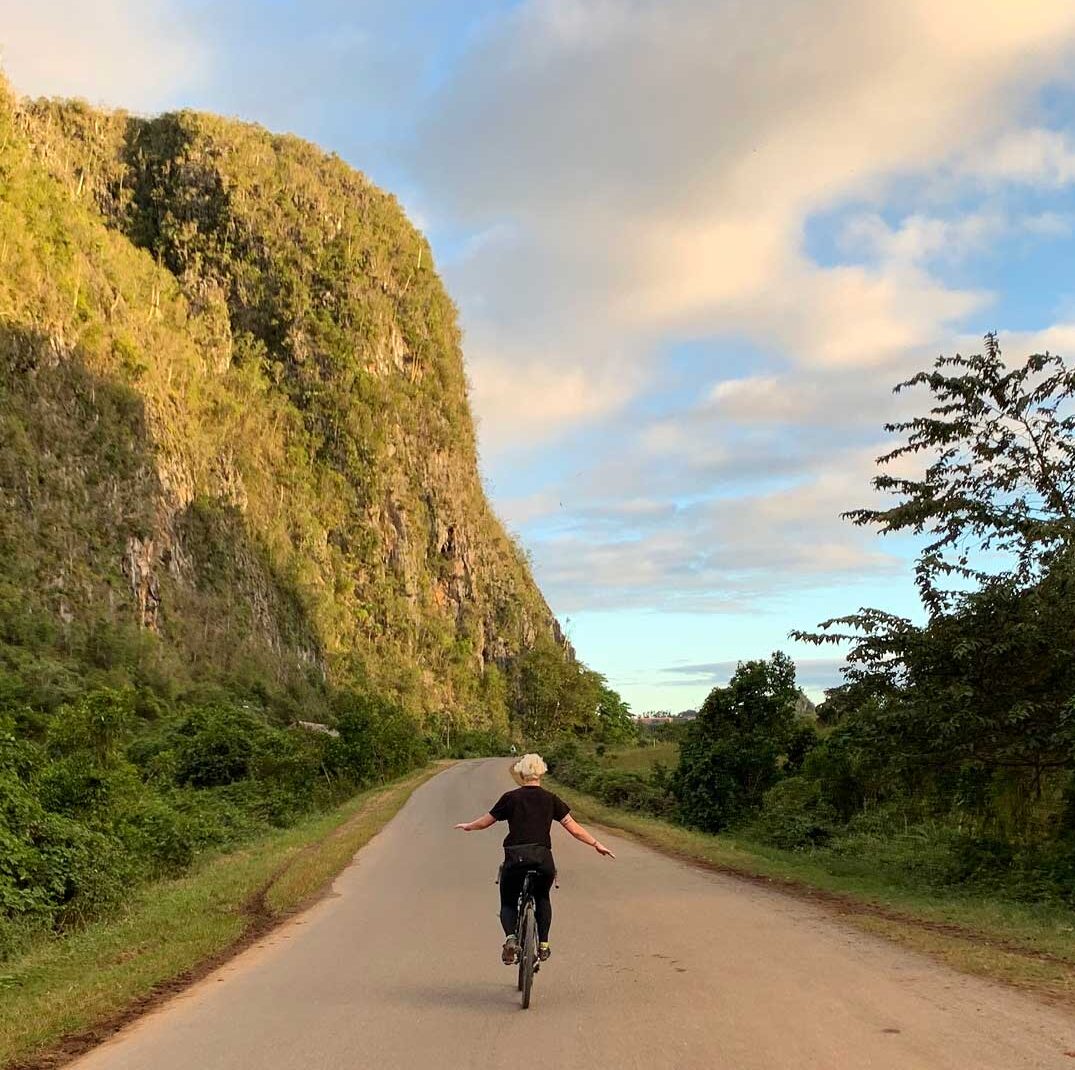
Had a great time presenting at Swift Industry’s Inaugural Virtual ‘Stoked Spoke’ Series. My presentation of my 460 mile ride across Cuba in December 2019 can be viewed here:
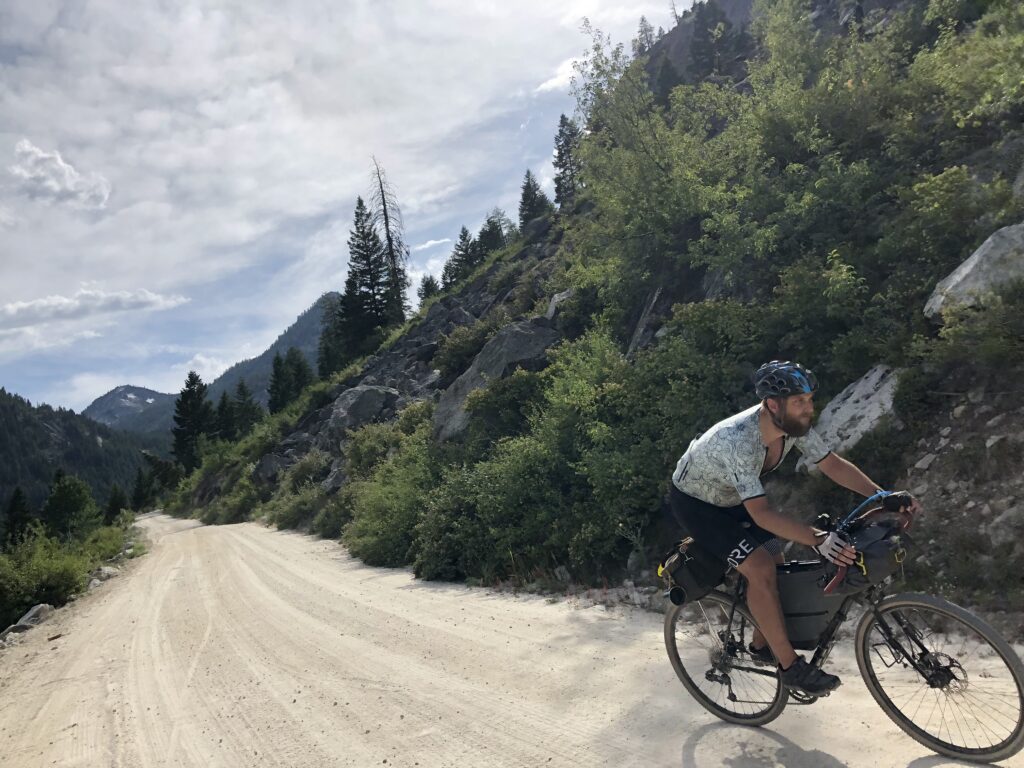
The Route The Idaho Hot Springs route was developed by the Adventure Cycling Association, a nonprofit that prepares bike touring routes and empowers people to travel by bicycle. The maps they produce are meticulously researched, marking every food store, bike shop and climb along your journey. Over the years I’ve explored much of their route network, often eschewing their careful preparation in favor of cutting my own course. I’ve daydreamed about the Hot springs Route for years, and following Adventure Cycling’s advice to the letter was much more appealing when traveling along unnamed forest service roads through a region with virtually no cell service. Their advice on hot springs is also on point, leading many locals to exclaim ‘How did you hear about that one?!’ when we mentioned our soaking itinerary for the trip.
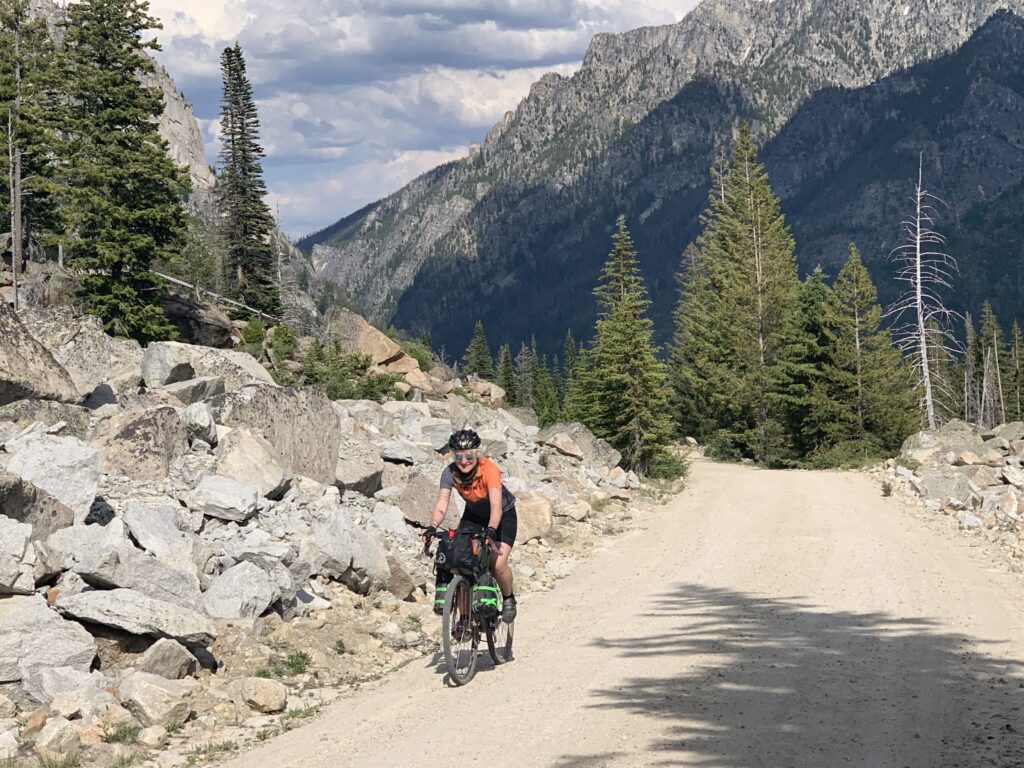
The main loop is 518 miles through occupied Shoshone territory, with a staggering 37,000 feet of climbing through the craggy peaks of the Sawtooth and Salmon River Mountain Ranges, primarily along gravel forest service roads. There are also over 200 miles of single-track mountain biking trails which loop off these roads, leading you even deeper into the forest. With time and vacation days both being limited resources, my partner Brandon and I opted to do just the northern half of the loop and found a DIY shortcut back to our car after 300 miles.
The Springs The Sawtooth range is gorgeous and all, but the real attraction was the hot springs. This region has the highest concentration of hot springs in North America. Here, the earth’s crust has been stretched thin by the intersecting mountain ranges, so that groundwater is heated by our planet’s core and shoots to the surface through fractures in the rock at temperatures around 180 degrees Fahrenheit. People have been drawn to these geologic oddities for as long as we know. The native Shoshone and Nez Perce people celebrated them for their spiritual, cultural, and medicinal qualities, making this region particularly important to their tribes. The route compiled by Adventure Cycling highlights 50 springs, ranging from developed lodges to small rock-walled pools.
What to bring and when to go The high mountain passes are only accessible from June, and snow starts accumulating in late September. The National Forest Service puts admirable effort into maintaining even the most remote paths, re-grading them once or twice during the short 4 or 5 months when the region isn’t snowbound, but many remote roads aren’t fixed up until midsummer. This window is cut short by the growing danger of forest fires in August. In early July, we found that most of the roads were well maintained and the effort of each climb was rewarded lavishly with clear skies and epic views (and did I mention the hot springs?). We encountered one stretch of road that hadn’t been re-graded, and these few hours were the only time where I doubted my choice to ride a steel gravel bike. Many people complete the loop on hardtail mountain bikes to be more prepared for these sections, but I found that would have been a bit too sluggish for my taste along the many miles of pavement and generally well-maintained forest service roads. We called the ranger station to check on the status of the roads on our loop before leaving, which was incredibly helpful. If you have any concerns or are considering a ‘short cut’, I would recommend this.
With tightly secured bags and 43mm+ tires, the route is easily traversable with a rigid touring or gravel bike.
It is essential to be prepared for emergencies and bring a pump or tablets to purify water. I made dehydrated meals for every day of the trip, however, we traveled through a town where we could replenish our snacks every day. Given the elevation gain, the best thing you can carry with you is LESS. Considering the relative isolation of the route, you don’t need to worry about folks judging your smelly clothes, using a toothbrush with the handle cut off, or drinking coffee out of your cooking pot. Some key items to add to your usual bike packing list:
Water filter. There are plenty of mountain springs but very few faucets.
Bug spray (and net and hat and screen and…basically there are a lot of bugs)
Whatever your potion to deal with rough roads is. This trip I was very into my 7-year-old saggy Brooks saddle, chamois cream, and two extra layers of gel bar tape over my brake hoods.
Food bag and rope to hang your snacks away from the critters (there are occasional bear sightings but no bear lockers)
Stories from the trip We started our trip from the small town of Crouch, on the fourth of July. My partner Brandon and myself made quite odd additions to the local 4th of July parade, our saddlebags waving behind us. We wove through barbecues and groups of children betting their allowances on duck races before turning off onto a gravel road and beginning the climb to Boiling Springs. The roads in the area are a bright white crushed gravel, which becomes tightly packed and generally smooth, and makes for a striking contrast against the shadows of the surrounding forests. We quickly climbed out of the dirt bike and four-wheeler traffic from the vacationers below, and easily found a campsite right next to the Middle Fork of the Payette with easy soaking access.
On the second day, we climbed over the North Fork Mountain Range, revealing Long Valley extending almost a hundred miles ahead of us. The route climbs over plenty of craggy peaks, which are perfectly balanced by fertile, boggy valleys at their bases. After bouncing down the rutted-out roads and rocky switchbacks on the west side of the mountain, we arrived on the lush valley floor. The road wound through pastures and past popular tubing spots, leading us straight to Clear Creek Station, the best combination RV park and pizza parlor I have ever experienced. Unfortunately, after ordering a pizza for four, two orders of Jalapeño poppers, and a side of fries, we remembered we still had 30 miles to go to soak in our preferred hot spring that night. After discarding all the empty plates, we revealed our map and realized we could easily knock off 2000 ft of climbing and 5 miles by veering off of the Adventure Cycling Route and following the North Fork of the Payette River through the valley to Gold Fork Hot springs. Gold Fork is the only developed hot springs we stopped at. Being able to grab another ice-cold seltzer water from the yurt/store just a few steps away from the pools made up for the constant squeals of children. Once we were completely sedated by the warm water, we realized we still needed to figure out where we were sleeping that night. The lovely gentleman running the springs offered to let us camp anywhere we wanted on the property and recommended a clearing tucked into the bend of the river.
Beginning the descent into Long Valley
On the third day, we wound through several small towns, all abuzz with summer visitors even though the roads a quarter of a mile outside their limits were almost completely car-free. We pursued the regionally renowned Roseberry Craft Market before stopping for breakfast at a bar primarily catering to the other type of biker in Cascade. From there we continued to McCall and filled up on pastries and cherries from their quaint lakeside farmers market before continuing out into the wild. Temporarily satiated, we looped around Little Payette Lake before pulling off the pavement and beginning the gravel climb up to Lick Creek Summit.
Suddenly, we were in the heart of the mountains.
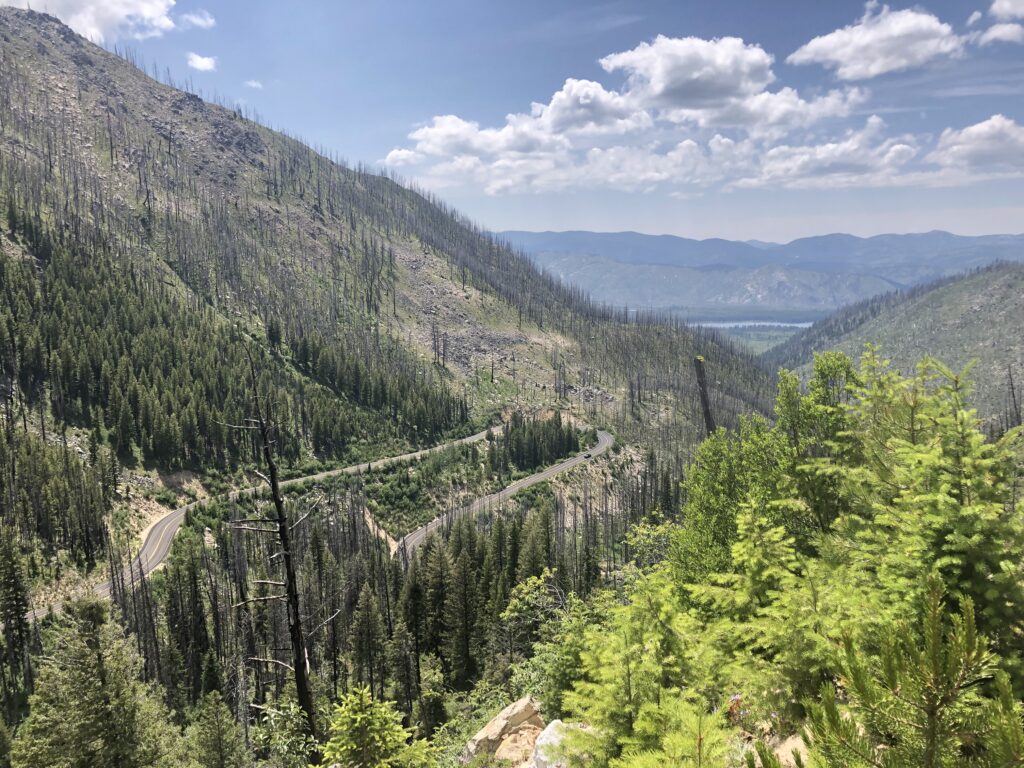
The road was dusty and hot, earning us pitied stares from several mountain bikers driving past us to start their rides at the top of the climb. It repeatedly pitched up, mandating several snack breaks, and inspiring a truck of concerned mountain bikers to stop and offer us some of their icy cooler water. The climb on the southern slope is nondescript, but after another 2,000 feet of elevation gain, the forest began to thin and open out into rock fields scattered with wildflowers. When we finally reached the top of Lick Creek Summit, the ground below us fell away into one of the most epic vistas of the entire trip. Suddenly, we were in the heart of the mountains. In any direction, there is nothing but steep granite rock faces crashing down into the river hewn crevasses below. The few trees are chiseled from the high mountain winters and cling onto the cliffs in impossibly tiny reservoirs of soil. We stopped to refill our water bottles from a glacial stream cascading through the boulders and wash off the dust from the 2.5-hour climb. Lick Creek Road is perched on the side of a cliff, making for an exhilarating descent. We bounced of huge chunks of the mountain that stuck out of the finely crushed gravel as we careened into the valley at 30 mph. The grade began to level out as we entered the pristine old-growth forests of the Payette National Forest, before bottoming out at the confluence of the Secesh River and the South Fork of the Salmon River.
Approaching Lick Creek Summit with that ‘OMG is this REALLY the TOP?!’ smile
We turned south, following the Salmon River deeper into the mountains. The few cars that passed us had giant poles with hooks and ropes attached to them. It took me a second to realize that the indigenous Shoshone and Nez Perce peoples still camp here, and many families had set up camp for the salmon run. We passed several campsites with tepees and huge family kitchens set up and saw more trucks go buy ladened with coolers full of fresh salmon and traditional fishing and camping gear. Almost 70 miles into a long day, we were relieved to land on pavement again. A thin road barely 10 feet wide carried us the last ten miles to camp. Almost delirious with exhaustion, we dumped our bags at 4 Mile Campground and stumbled one last mile to 16 Mile Hot springs (I know, my math was getting pretty fuzzy at this point too). This soaking spot was one of the gems of the trip. A few rock pools are tucked into the rocky walls of the Salmon River, Just a few feet away from its icy water but over 100 degrees Fahrenheit. After a long soak and a few plunges into the river, the miles practically melted off our quads. That evening we shared our campsite with an extended native family, who were cooking a veritable feast of wild-caught salmon over a roaring fire. When we finally settled into camp at almost 9.30pm, our dehydrated mac and cheese and curry pouches tasted like the most delectable feast themselves.
The next morning, we continued to follow the tiny little road along the Salmon River. The route hugs the shore, before climbing up a few hundred feet to another vista and then descending back into the valley. In another 5 miles, the mountains on either side of us began to open, releasing us into an alpine meadow. Still stiff from the previous days’ climb, we were happy to forgo the epic vista for the views of an almost endless field of wildflowers. We stopped at The North Shore Lodge along the extensive shores of Warm Lake, where I had one of the most satisfying grilled cheese sandwiches of my life and at least 5 glasses of cold, icy sweet tea… made only slightly less sweet by the raised eyebrows we got from the car driving folks at the bar when we told them we were heading up to Deadwood Summit. We ordered another serving of jalapeño poppers because we knew there was a big climb coming up.
By this point, it was 90 degrees and the easy rolling and extra speed of the blacktop did not make up for heat radiating off it. We began trudging up Landmark Rock, accompanied only by the eerie howling of the wind through a few emaciated stands of trees. The road wound into the mountain, charting an illogical course which I refuse to believe was the least painful way to the top. After a dozen switchbacks or so, we reached a saddle in the ridge with sweeping views over Warm Lake and across the valley that was funneling the wind into our faces. After an invigorating 1k descent, we turned off the pavement and began the trudge up to Deadwood Summit. Even in early July, the snow at 7,000 feet hadn’t been melted for long enough for the Forest Service to grade this road. The center of the road was worn into a relentless washboard, and the sides were pockmarked by giant potholes. We wove back and forth across the road, failing to find a line that was a bit easier on the wrists, and dodging the RVs which were somehow much more prevalent on this stretch of road than any of the others leading to it. The elevation and the relentless shaking were wearing me down, and Brandon’s supportive reassurances that we were getting close to a snack stop started to seem more ridiculous as my pessimism grew and the shadows in the never-ending woods on every side of us started to get longer.
Fueled by his encouragement (and several packets of gels), we finally passed a rather unremarkable sign reading ‘Deadwood Summit: 6860′ and began a rough and rutted descent. The road finally dropped us in front of a 20-foot-tall sign welded from horseshoes reading DEADWOOD OUTFITTERS. When the dust settled, we realized that we had stumbled on a dude ranch that offers wolf hunts along the outskirts of the River of No Return Wilderness, and more importantly DORITOS. After smashing two bags of chips under the glassy-eyed stares of several elk heads, we felt well enough outfitted to take on the next 18 miles of poorly maintained roads to Bear Valley Campground. With no one to be found within ten miles of us, I stripped down and jumped into the cool stream that surrounded our campsite to soak my aching wrists. The next day we veered off the Adventure Cycling route, cutting across the Boise National Forest on a wide road we had verified were well graded with a ranger and the hunting guides at Deadwood. It was a relief to turn on to a road that was level and start moving along at a jauntier clip. We descended back down to the Payette River along a series of white-knuckled switchbacks, drawn forward by the next hot spring and a hefty dose of gravity. For our grand finale, we stopped at one of the most striking hot springs on the route, Pine Flats, which (somewhat ironically) was easily accessible from a paved, well-marked parking lot just off the County Highway. From a series of pools that are built into the side of the cliff above the river, you can peer over the sulfur yellow rocks and watch the turquoise rapids 100 feet below. Refreshed and slightly less dusty, we headed back to the car ready to face the challenges of everyday life again.
Race day is finally here! You have worked HARD for this, and now it’s finally time to strut your stuff.
Eat for sustained shredding
Have a light breakfast, but eat something sustaining. Try to eat something that’ll be easily digested and have you full until you get to the race course (oatmeal is a great option). You will be snacking before and after the qualifiers. It’s important to keep hydrating all day so you are in go mode when its time for the finale. Bring energy gels or some shot blox to chomp on right before you race to keep yourself from bonking.
Take a deep breath
When you get to the race course, shake off all your nerves. You’re here to have fun, you’re here to see your friends. Now time to get to business. Visualize your day going well, no if and or buts about it. We’re here to create some personal records, not to put yourself in danger. Evelyne Gangon reiterates the importance of riding the course before the race ‘You don’t want to be surprised during the race! If you can during the warm up, try to take corners at different speed and see how comfortable you are.’
Cornering
One of the things that makes criterium racing exciting are the tight corners you will encounter on the course. Take a deep breath, you know how to handle these. Evelyne Gagnon wants to remind you that if you have to slow down, do it before the corner. Start ‘soft’ pedaling if you are on a fixed gear bike – DON’T skid (there is someone right behind you!). The line to take a corner should be outside-inside. As you enter the corner, look where you are going not at what you are about to run into – your bike will follow your eyes (trust me). Practice this during your pre-ride. During the race, focus on the cyclist just ahead of you (you ARE going to catch them) not the curb or the metal barrier. Tori Riemersma summed this all up succinctly in the oft heard phrase – ‘HOLD YOUR LINE!’
Look through the corners – your bike will naturally follow your eyes
Create a pre race routine to keep your stress levels in check
Leave enough time to get everything set up before your first race – Chelsea recommends leaving at least an hour so you can begin stretching and warming up. Your helmet, gloves, glasses, socks and shoes should be in close proximity. Skinsuit and numbers should be on. This is also a time to eat a very light snack or energy bar, and get the bathroom line out of the way. With 45 minutes to go, hit the rollers with your full gear on. Start with a 20 minute warmup with gradual increase of cadence and heart rate to get the legs and lungs going, along with three- six second sprints mixed in and a cool down until it’s time to stage for the qualifiers.
Maintain composure and focus on your own performance
Now it’s almost time for your big event. When it’s time to head to staging, start calming breathing techniques. Everyone’s heart rate naturally goes up due to the mixed emotions, but we want to make clear minded decisions – The rest is all mental! Try to keep your heart rate as calm as possible.
Keep your game face ON
Race tactics
Now we get to the tactical part of the event. You may not be the fastest racer, but you can be the smartest. Chelsea explains – ‘It’s all about being calm and collected and thinking strategically. If you know your weaknesses, you know your strengths even more. Use them to your advantage.’ Even if you are racing solo there are plenty of opportunities to work with other racers; If you feel yourself getting tired, draft and recover. Don’t take too long to recover on one person though, only a few seconds- then jump to the next wheel front and continue drafting. This way you can conserve your energy even as you move up in the race.
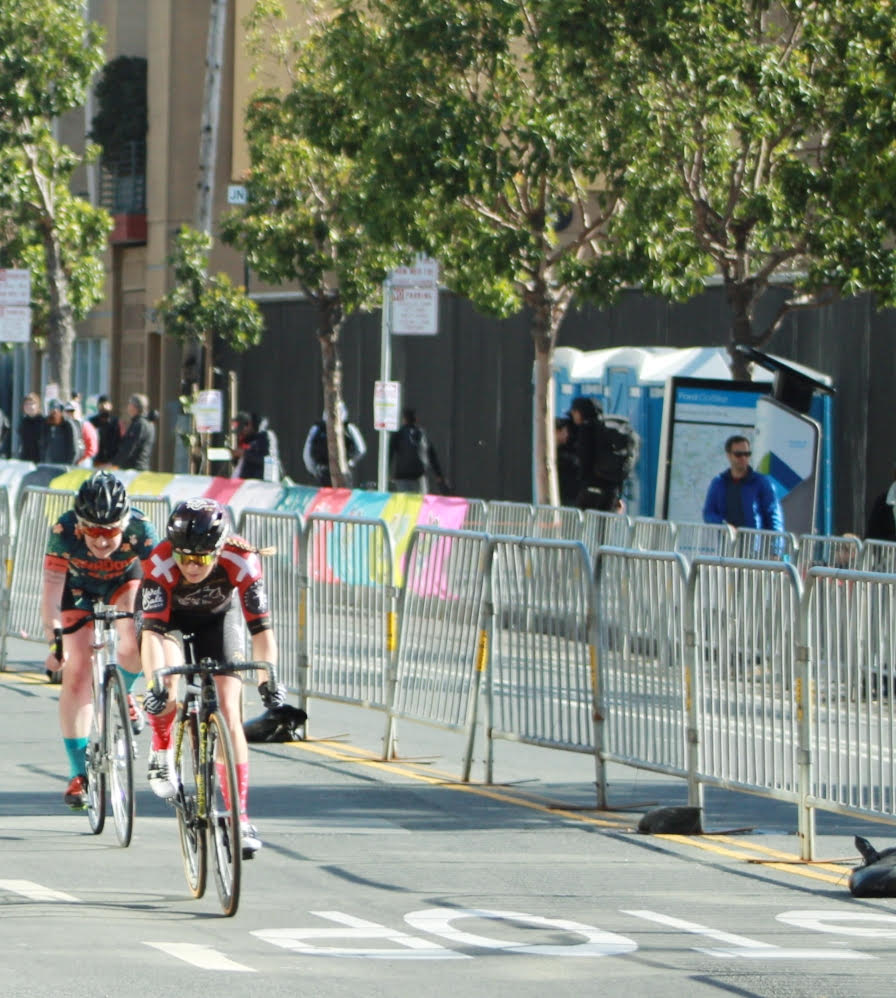
Now you are in position to start controlling the pace of the race so it works for you. Most cyclists are either sprinters – who can put out short incredibly powerful efforts, or endurance racers who can hold a fast pace for a long time. If you are more of a sprinter, your goal should be to find a strong cyclist you can draft behind, and plan to sprint around them at the finish line. If you are an endurance racer, you can either to break away from the pack and maintain a higher pace for the remainder of the race, or attack repeatedly until all the sprinters are worn out. At Mission Crit, Dazie (an endurance racer) was able to lead out Evelyn (a sprinter). This way Evelyn saved her energy until it was time to sprint around Dazie and attack off the front, making use of both of their skills. ‘Attack like you mean it!’ says Britt Mason ‘Avoid attacking off the front or from the back. Attacking from somewhere in the top 10 positions is ideal.’ This is when you will have to really push yourself. ‘You need to attack when everyone is already in red zone (including you), attacking when it’s easy will rarely succeed.’ Says Evelyne Gagnon. It may seem counter intuitive to start sprinting when your legs are already screaming, but Tori Riemersma sums it up like this ‘Attack when it’s fast, sit in while it’s slow. If other people are relaxed from the pace, the likelihood of getting away is lower.’ Keep in mind your positioning, and always try to improve it – MOVE UP!
Always have a Plan B
Of course, sometimes things don’t go as planned. Having a secondary goal can help you keep pushing yourself and keep any self-doubt at bay. This can be something for the team, or something personal. During Mission Crit, Tori’s rear cog came loose during the qualifier event, and she had to start the main event from the rear of the pack. This ruined her chances of getting on the podium, so she turned her attention to helping our other team mates on the course. Kate shares an example from her racing career ‘I ended up getting dropped half way through the race. My nerves got the best of me and I was super stressed and panicking, but then I remembered my secondary goal- to just finish the race no matter what my position was… Having my secondary goal allowed me to regain my inner focus, calm my nerves, and lower my heart rate after being dropped. It was still a personal win for me because I actually finished.’ Most importantly, don’t be a jerk, and let some things roll off you. If you feel like you were cut off by another rider or that they were racing dangerously, remain focused on your own performance. If you feel inclined to discuss their behavior later, you can do so privately after the race.
Set yourself up for a strong finish
There’s a bell! That means it’s the last lap. Make sure you don’t get boxed in- being in the middle is fine during a race because you are sheltered from the wind, but you don’t want to get stuck behind riders that are slowing down if they did start to sprint early enough. Start setting yourself up for the final sprint – you want to be ready to MASH as you come around the last corner. This is where you let it ALL OUT. Just keep breathing …. focus on the finish line – YOU DID IT! I can’t wait to talk to you about everything you just achieved at the after party!
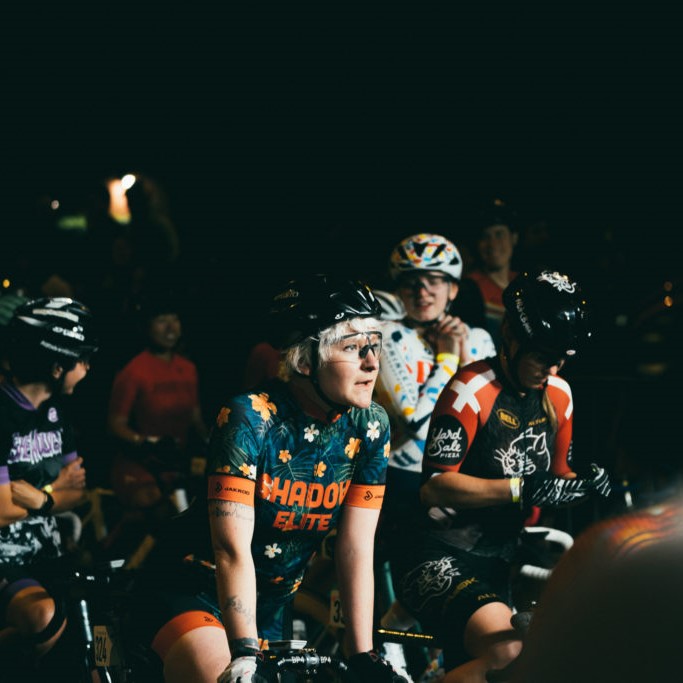
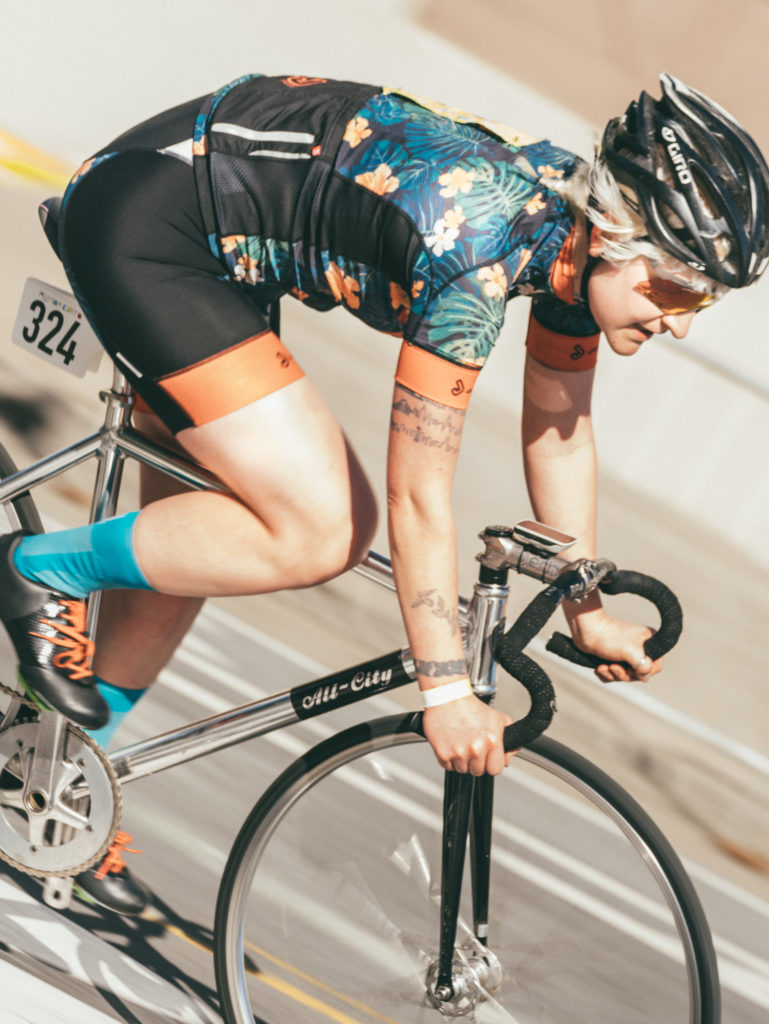
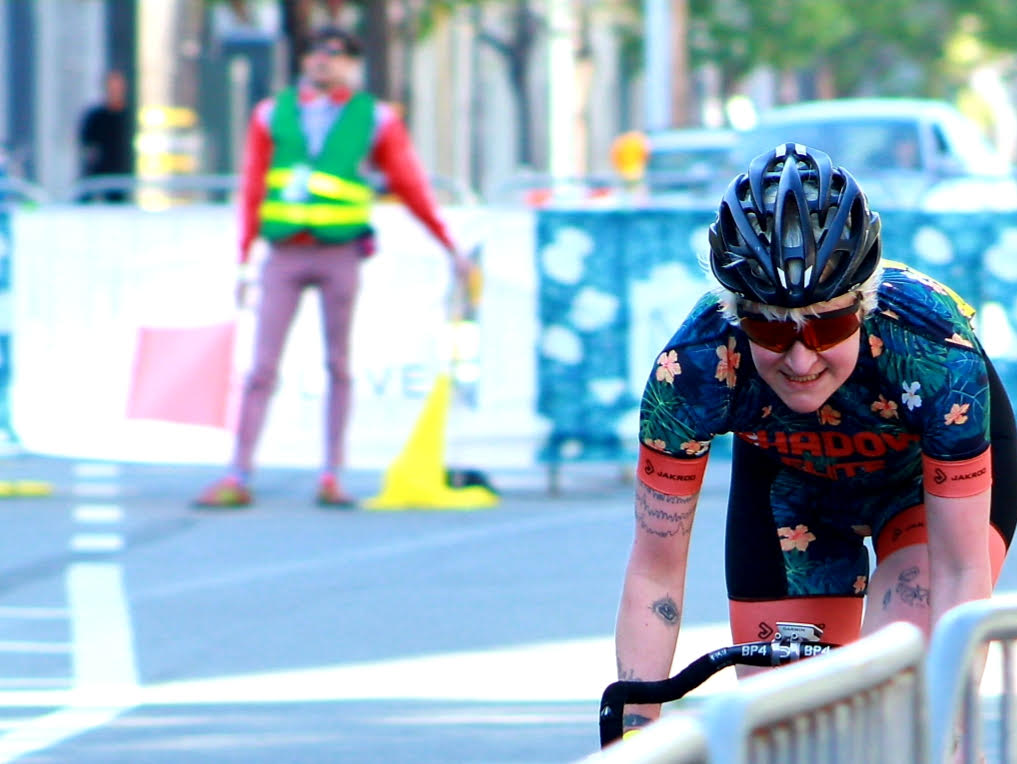
Last weekend was Mission Crit, which for many folks marks the beginning of race season. On top of that, the WTF race was billed as the feature event this year, which for even more of us marks a major landmark in drawing attention to Women/Trans and Female identifying bodies in sport. My teammates at Shadow Elite Racing and myself have written this post in the interest of stoking the stoke that is building around this race and our collective future in cycling, and encouraging more new faces of every type to get out there and shred. Here are some tips for training for the races ahead and tricks for excelling at the fast, technical courses that characterize criterium races, on the fixed gear bikes that make Mission Crit so uniquely thrilling.
1. Hydrate and Sleep
Bike racing is often portrayed as a competition of brawn, and the popular representation of the race often leaves out the self-care and mental preparation that will take you from being a strong rider to a great racer. My philosophy is that most everything (including your cycling skillz) are made better with more hydration and sleep. This only increases in importance as race day approaches, so beginning a week before your race, (and even before that – take care of yourselves!) hydrate, hydrate, hydrate. A dehydrated body equals a higher heart rate. If you remain hydrated, you can keep the high stress situations you will encounter at bay.
2. Simulate
When you are training, you want to make sure you ENVISION this race, so there’s no huge surprise to your body day of. Watch race videos – past races, new races, of this specific course or ones similar to speed and grouping. You’ll see lots of folks jump out of the saddle and attack in quick, short sprints, trying to drop the racers just behind them. Practice sprints like this, imagining the thrill of sprinting around the cyclist you’ve been chasing down. Exercises like this are called openers.
Team crusher Chelsea Mattias offered to share her super top secret opener routine, which she does the week before a big race:
‘You don’t want your legs to stiffen up, so do a simulation of your race around where you live or on a trainer. You can simulate a course like Mission Crit by doing a 30 second uphill sprint, 30 second easy to simulate the downhill, and 1 min hard for the long straightaway at the backside.’
3. Stretch
Through your training, make sure you listen to what your body needs and take care of it. Try to foam roll or stretch every day. This is important, when you get to the course you want your body to be 100% in connection with your mind. They are constantly listening to each other. A nimble body is a fast reacting, fast sprinting, fast to the finish line-body.
4. Don’t Get Spooked & Change Your Setup
When selecting the gear you will need for any race, the most important thing is to have something YOU are comfortable riding. “No last minute dramatic bike changes!” Says our organizational maven Kate Von Merwitz. “Sometimes this is unavoidable, but sometimes new adjustments can completely throw you off. If there are changes that need to be made to your setup, aim to get it sorted at least a week before the race so you aren’t fiddling around with your fit the night before or day of the race.”
5. Choose Your Tire Pressure
Fixed gear bikes are super simple speed machines, so put some thought into the two elements of your rig you have the most control over: tire pressure and gear ratio. Lower tire pressure helps you ‘grip’ the corners better, but higher pressure rolls faster, so you want to find the balance between these two. I generally run 70-80 psi. Another thing that helps in the corners is running slightly wider tires and rims. All around stellar cyclist Evelyn Sifton’s sweet spot for events like this is 25-28c.
6. Choose your Gear Ratio
For your gear ratio, choose something that fits your fitness level and your strengths. 49 tooth Chain ring and 15 tooth cog, resulting in a ratio of 86 gear inches, is the most common gear ratio for fixed gear crits. However, some people have stronger legs and others can spin their legs faster. These two people would have to choose different gear ratios to go the same speed. More gear inches make you go faster, but a ‘lighter’ (= less gear inches) ratio allows you to accelerate faster, so keep this in and consider the specific challenges of the race while you select your ratio. Unlike most races on the road or track, there are few straightaways in a criterium and the corners are tight. You want to select a gear that allows you to keep up with someone in your field who is ‘attacking’ so you can stay in their draft, or if you are less confident in cornering, allows you to slow down to make it safely through a sharp corner and then quickly accelerate again.
No matter what your skill level, everyone will generally you want lower gear ratio for more technical courses. If you are on the fence about which ratio to choose, remember that your lungs recover faster than your leg muscles, so better to choose a gear where you will be spinning at a very high cadence than one where your leg muscles are going to cramp up and die.
7. Pack and Prep
You don’t want to be stressing when you get to the event. Pack all the gear you need the night before. That includes plenty of snacks (Evelyn Sifton is powered purely by chocolate chip cookies, while I prefer sweet potatoes, and a few Shot Blox right before the race), and make sure your water bottle is filled with Nuun or whichever hydration pack you use. A change of clean, warm clothes is crucial to slip on in between qualifiers and the main event. Finally, have chain rings and cogs you think you might need for your desired gear ratio.
And now tuck yourself into bed and sleep tight. Tomorrow, we race!